SUSTAINABLE
consumption
The illusion of
How the global eel trade exposes the hidden contradictions of sustainable consumption, luxury markets, and ecological collapse
by Sezer Ali | JUN 15, 2026 | SUSTAINABILITY
In dark plastic containers hidden inside suitcases, millions of transparent baby eels cross European borders every year. They are so small they resemble strands of glass — and so valuable that investigators have described them as “the cocaine of the sea” (BBC Eye Investigations, 2025). The BBC documentary Eels: Billion Dollar Babies traces how global demand for eel has fuelled one of the world’s most lucrative wildlife trafficking industries: a sprawling network of smuggling operations, organised crime, and ecological collapse stretching from European rivers to Asian aquaculture farms (BBC Eye Investigations, 2025).
Yet this is not simply a story about crime. It is a story about a far more uncomfortable contradiction at the heart of contemporary consumer culture: the illusion that sustainability can coexist indefinitely with extraction. The European eel (Anguilla anguilla), now classified as Critically Endangered by the International Union for Conservation of Nature (IUCN), has experienced a catastrophic population decline of more than 90 per cent since the 1980s (Dekker, 2003; IUCN, 2025). Despite this ecological collapse, international demand continues to grow, transforming scarcity itself into a profitable commodity.
The paradox becomes even more striking within the eel farming industry, often presented as a sustainable alternative to overfishing. Unlike salmon or seabass, eels cannot yet be commercially bred on a large industrial scale. Most eel farms, therefore, remain dependent on the capture of wild juvenile eels – known as “glass eels” – harvested from European estuaries before being trafficked or exported to aquaculture facilities in Asia (Shiraishi and Crook, 2015). In other words, the industry marketed as “farmed” still relies fundamentally on the depletion of wild populations.
This dependence has helped create an illegal trade estimated to be worth billions of euros annually. According to investigations by Europol and international environmental agencies, organised criminal networks exploit loopholes in global supply chains, smuggling glass eels from Europe into East Asian markets where eel consumption remains culturally and economically significant (Europol, 2023). As demand intensifies, endangered species are transformed into speculative assets — their rarity increasing their market value rather than limiting exploitation.
The eel trade ultimately reveals a broader pattern embedded within modern systems of consumption. Across industries — from fast fashion and carbon offsetting to industrial agriculture and “green” supply chains — sustainability is frequently framed as a marketable aesthetic while extractive structures remain intact (Monbiot, 2022). The language of ethical consumption often obscures the environmental violence hidden within global logistics networks, where ecosystems become increasingly financialised and scarcity itself becomes profitable.
In this sense, the European eel is more than a critically endangered species. It has become a symbol of a global economy that no longer waits for extinction to occur before generating profit from it. Instead, extinction itself becomes part of the business model.


Millions of juvenile eels cross European borders every year concealed in bags like this one — each container representing thousands of euros in illegal profit and one step closer to the collapse of a species.
THE MYSTERY OF THE EEL
For centuries, the eel existed as one of nature’s great biological mysteries. Unlike most fish species, no one had ever witnessed eels mating in the wild, nor could scientists explain how creatures inhabiting European rivers and estuaries appeared to vanish into the ocean before returning again in new generations. Even Aristotle famously believed eels emerged spontaneously from mud, unable to identify any reproductive organs within them (Schmidt, 1923).
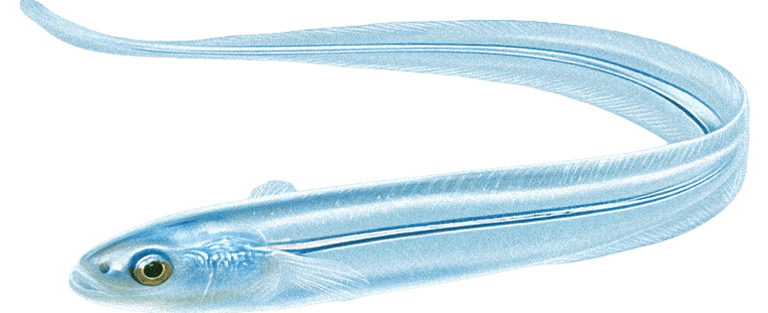
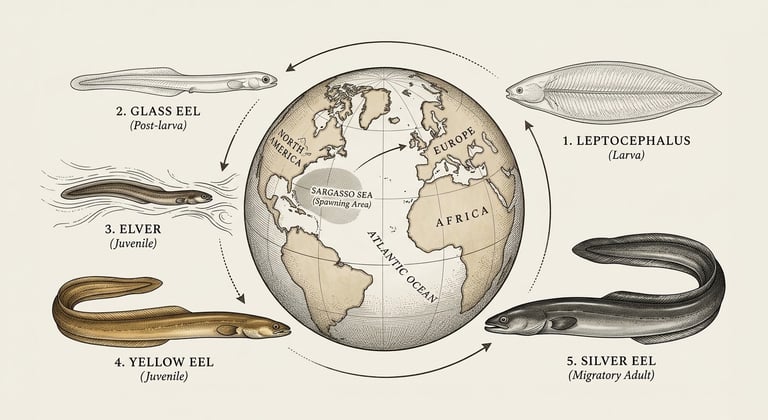
It was not until the early twentieth century that Danish biologist Johannes Schmidt traced the eel’s extraordinary migratory cycle across the Atlantic Ocean. His research revealed that the European eel begins its life thousands of miles away in the Sargasso Sea — a vast region of the North Atlantic bounded not by land, but by ocean currents (Schmidt, 1923). From there, transparent larvae drift towards Europe for months, sometimes years, carried by currents before transforming into the tiny translucent creatures known as “glass eels".
These juvenile eels arrive along the coasts of Spain, France, Portugal, and the United Kingdom, where they migrate inland into rivers and wetlands. Over time, they darken in colour and mature into yellow eels before eventually transforming again into silver eels, beginning the long migration back to the Sargasso Sea to reproduce and die (Righton et al., 2016). Their lifecycle is so complex and fragile that scientists still struggle to fully understand many aspects of their reproduction.
This biological mystery is precisely what makes the species so vulnerable to industrial exploitation. Because eels have proved extraordinarily difficult to breed commercially in fully controlled conditions, the global eel farming industry remains dependent on capturing wild glass eels at the very beginning of their life cycle (FAO, 2024). Every farmed eel therefore begins as a wild animal.
The consequences are profound. Each winter, estuaries across Europe become extraction zones where licensed fishers, illegal poachers, and organised trafficking groups compete to capture juvenile eels before they disappear inland. In regions such as the Bay of Biscay and the Severn Estuary, glass eels have become among the most valuable wildlife commodities by weight in the world (Hinsley et al., 2023). Their near-transparent bodies — delicate enough to fit inside plastic bags or concealed containers — move through hidden logistics networks spanning airports, ports, and international black markets.
What emerges is a striking contradiction between ecological complexity and economic simplification. The eel is an animal shaped by vast oceanic systems, seasonal rhythms, and evolutionary adaptation over millions of years. Yet within global markets, it is reduced to inventory: a luxury food product circulating through opaque supply chains governed primarily by scarcity and price.
The mystery of the eel, once one of biology’s great unanswered questions, has now become something else entirely — a symbol of how modern industries attempt to industrialise even the most fragile and least understood forms of life.
A Journey of Thousands of Miles
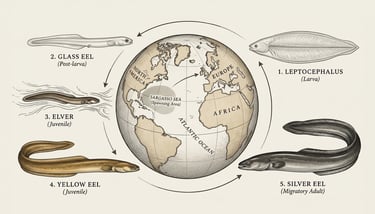
The extraordinary life cycle of the European eel — beginning in the Sargasso Sea and crossing the Atlantic Ocean before reaching European rivers. A journey of thousands of miles, millions of years in the making, and increasingly impossible to complete.
ADVERTISEMENT
THE SUSTAINABILITY ILLUSION
Few industries illustrate the contradictions of modern sustainability discourse more clearly than eel aquaculture. Across promotional campaigns, restaurant supply chains, and seafood certification systems, fish farming is frequently presented as a solution to overfishing — a controlled and efficient alternative capable of reducing pressure on wild ecosystems (FAO, 2024). Yet in the case of eels, the logic begins to collapse upon closer inspection.
Unlike salmon, trout, or seabass, eels have resisted full industrial reproduction in captivity for decades. Although scientific breakthroughs have achieved limited artificial breeding under laboratory conditions, commercial-scale eel farming remains overwhelmingly dependent on the capture of wild juvenile eels from European rivers and estuaries (Okamura et al., 2014). The industry marketed as “aquaculture” therefore continues to rely upon the extraction of critically endangered wildlife.
This contradiction exposes a broader problem embedded within contemporary green capitalism: sustainability is often framed not as the reduction of extraction, but as the optimisation of extraction. Rather than fundamentally questioning patterns of consumption, many industries focus on making existing systems appear more efficient, technologically advanced, or ethically manageable (Monbiot, 2022). The result is a form of sustainability centred less on ecological limits and more on maintaining consumer demand without disrupting economic growth.
In this context, eel farming becomes emblematic of a wider cultural illusion. Restaurants may advertise responsibly sourced seafood; retailers may invoke traceability and environmental awareness; consumers may associate aquaculture with conservation. Yet beneath these narratives remains a hidden dependence on wild ecosystems already pushed to the brink of collapse.
The opacity of global supply chains further intensifies this illusion. Glass eels harvested in European waters may pass through multiple intermediaries before reaching farms and markets across East Asia, where eel consumption — particularly in Japan and China — remains both culturally significant and economically lucrative (Crook and Nakamura, 2013). Within these transnational networks, legal and illegal trade frequently intersect, making transparency increasingly difficult to maintain. Investigations by Europol have repeatedly identified organised criminal groups exploiting the enormous price difference between European capture zones and Asian consumer markets (Europol, 2023).
What makes this system especially revealing is the way scarcity itself increases economic value. As eel populations decline, prices rise. Rarity does not diminish demand; it intensifies profitability. In this sense, ecological collapse becomes financially productive. The market responds to environmental crises not necessarily by slowing extraction but by transforming endangered species into luxury commodities whose value is amplified precisely because they are disappearing.
This dynamic extends far beyond the eel trade. Similar contradictions appear across numerous industries marketed through the language of sustainability: fast fashion collections labelled "conscious", carbon-neutral aviation schemes, recycled plastic supply chains, or electric technologies dependent on extractive mining practices in the Global South (Raworth, 2017). In each case, sustainability risks functioning less as systemic transformation and more as a mechanism for stabilising consumer confidence.
The illusion is not simply that consumption can become sustainable. It is the belief that endless consumption itself can remain compatible with finite ecological systems. The story of the eel exposes how fragile that assumption truly is.
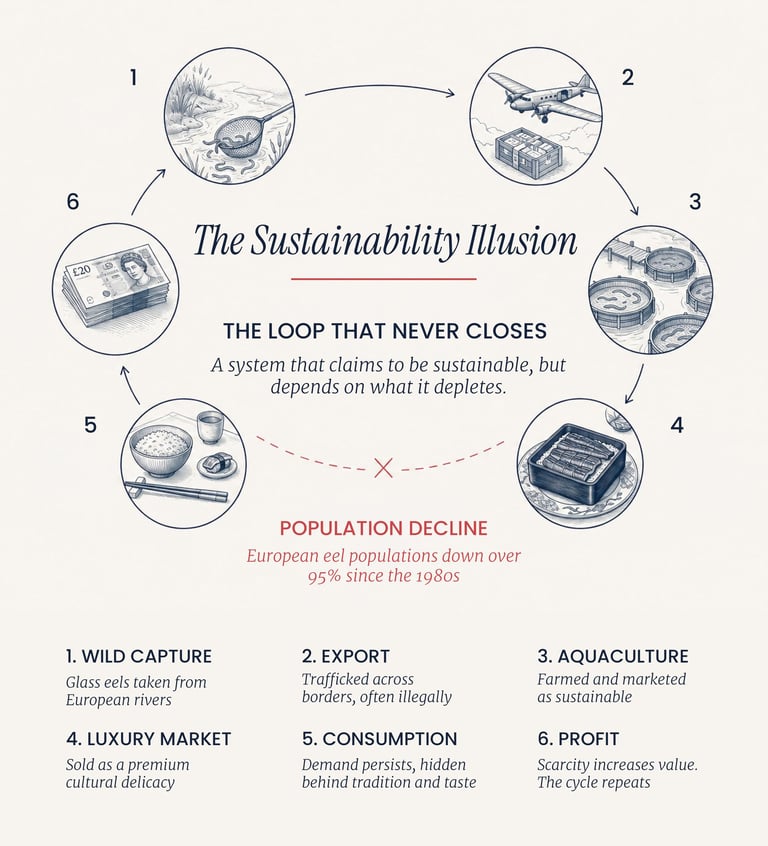
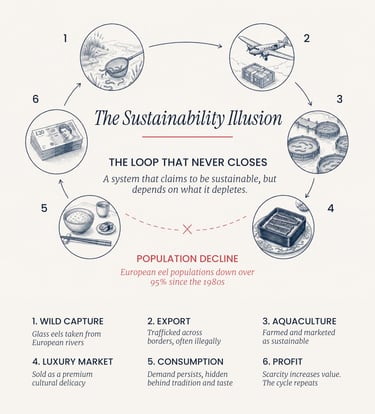
A system marketed as sustainable, built on extraction. The eel aquaculture industry depends on wild capture at every stage — and the numbers tell the rest of the story.
LUXURY, APPETITE, AND EXTINCTION
The global eel trade is sustained not only by scarcity but also by desire. Across parts of East Asia — particularly in Japan, China, and South Korea — eel has long occupied an important place within culinary culture, associated with seasonal rituals, nourishment, and luxury dining traditions (Bestor, 2004). In Japan, dishes such as unagi kabayaki are deeply embedded within cultural and historical food practices, especially during the summer period known as Doyo no Ushi no Hi, when eel consumption is believed to restore strength during extreme heat (Ashkenazi and Jacob, 2000).
Yet as with many culturally significant foods under global capitalism, tradition has increasingly merged with industrial-scale consumption. What was once regionally limited and seasonally consumed has become integrated into transnational systems of mass distribution, refrigeration, aquaculture, and speculative trade. Eel is no longer simply a cultural delicacy; it has become a global luxury commodity circulating through highly financialised supply chains.
This transformation reflects a broader phenomenon within contemporary consumer culture: the conversion of ecological rarity into prestige. Across luxury markets, scarcity often functions as a marker of exclusivity and status. Whether in bluefin tuna auctions, exotic hardwoods, rare animal products, or limited natural resources, declining availability can intensify symbolic value rather than encourage restraint (Clark and Clausen, 2008). The endangered become desirable precisely because they are endangered.
In the case of the European eel, this logic produces a deeply unsettling paradox. As populations continue to collapse, the market value of glass eels increases dramatically. According to investigations by environmental agencies and European law enforcement, juvenile eels can fetch thousands of euros per kilogram on Asian black markets, making them among the most profitable wildlife commodities in the world by weight (Europol, 2023). Ecological fragility is transformed directly into economic opportunity.
The aesthetics surrounding luxury seafood further obscure the violence embedded within these systems. In high-end restaurants, eel is presented as craftsmanship: carefully grilled, lacquered with sauce, served with elegance and ritual precision. The consumer rarely encounters the invisible infrastructures behind the plate — the depleted estuaries, smuggling routes, airport seizures, or collapsing river ecosystems that made the product possible. As environmental scholar Rob Nixon argues, much ecological destruction operates as a form of “slow violence”: gradual, dispersed, and largely hidden from immediate public visibility (Nixon, 2011).
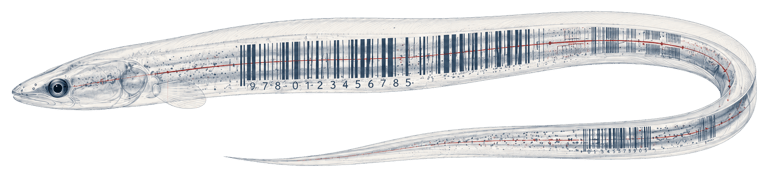

A creature shaped by millions of years of evolutionary mystery, reduced to a barcode.
This invisibility is central to the functioning of global consumption itself. Modern supply chains are designed to maximise convenience while distancing consumers from extraction. Products appear detached from landscapes, labour, and ecological consequences. The supermarket, the luxury restaurant, and the digital marketplace all contribute to a culture in which environmental costs become geographically and psychologically remote.
The eel therefore occupies a uniquely symbolic position within the contemporary ecological crisis. Its migration once connected oceans, rivers, and continents through one of nature’s most extraordinary life cycles. Today, that same migration has been absorbed into global systems of logistics, speculation, and consumption. A creature shaped by mystery and evolutionary endurance now circulates primarily as high-value cargo within a market increasingly capable of monetising disappearance itself.
In this sense, the eel trade reveals something larger than illegal trafficking or unsustainable fishing practices. It reveals how modern consumer capitalism transforms appetite into an ecological force — one capable not only of exploiting nature but also of accelerating extinction while simultaneously aestheticising it.
ADVERTISEMENT
CRIME FOLLOWS SCARCITY
Whenever a species becomes sufficiently rare, profitable, and globally desired, criminal networks inevitably emerge to exploit the gap between environmental regulation and market demand. The illegal eel trade demonstrates how ecological collapse can generate not only environmental crises but also entire underground economies structured around scarcity itself.
Since 2010, the export of European glass eels outside the European Union has been prohibited under CITES regulations designed to protect endangered species (CITES, 2025). Yet despite these restrictions, investigators estimate that hundreds of millions of juvenile eels continue to be trafficked illegally from Europe into Asian markets every year (Europol, 2023). Conservation laws have not eliminated demand; they have instead intensified the profitability of circumventing the law.
According to Europol, wildlife trafficking has become one of the world’s largest forms of organised transnational crime, generating billions annually alongside narcotics, arms trafficking, and human smuggling (Europol, 2023). The eel trade occupies a particularly revealing position within this economy because of the extraordinary value concentrated within such a small and fragile commodity. A suitcase containing live glass eels can be worth hundreds of thousands of euros once transported successfully into East Asian aquaculture markets.


When a species becomes sufficiently rare and globally desired, its market value begins to outweigh its ecological existence. The European eel has crossed that threshold.
The logistics of the trade resemble the infrastructures of other global black markets. Glass eels are concealed in plastic bags filled with oxygenated water, hidden inside luggage, vehicles, or commercial shipments moving through major European airports and ports (BBC Eye Investigations, 2025). Smuggling routes frequently pass through intermediary countries in order to obscure origin and bypass customs inspections. Investigations conducted across Spain, France, Portugal, and the United Kingdom have revealed highly coordinated trafficking operations involving fishers, exporters, transport brokers, and organised criminal intermediaries (Interpol, 2022).
What makes wildlife trafficking particularly difficult to combat is the increasingly blurred boundary between legal and illegal markets. Licensed fishing quotas, legal aquaculture operations, and international seafood supply chains often intersect with illicit activity, creating systems in which traceability becomes extremely difficult to guarantee (Hinsley et al., 2023). Illegal glass eels can enter broader commercial networks through laundering mechanisms that disguise origin and legality before reaching farms, wholesalers, and eventually restaurants.
This ambiguity exposes a deeper structural problem within global capitalism: illegality often functions not outside the system, but within it. Black markets do not emerge separately from legitimate economies; they frequently evolve through the same infrastructures of trade, logistics, finance, and consumer demand. The eel trade depends upon airports, refrigeration technologies, international shipping routes, and luxury food industries no less than legal commerce does. Organised crime merely occupies the spaces where regulation fails to constrain profitability.
Environmental crime has historically received far less political attention than other forms of organised criminal activity, despite its enormous economic and ecological consequences (UNEP and Interpol, 2020). Wildlife trafficking is frequently perceived as secondary to narcotics or arms smuggling, even though the destruction it accelerates may prove irreversible. Species collapse, unlike financial loss, cannot easily be recovered once ecological thresholds are crossed.
The illegal eel trade therefore reveals something profoundly unsettling about the contemporary relationship between markets and nature. Scarcity no longer functions as a warning sign demanding restraint. Instead, scarcity itself becomes the engine of financial opportunity. The closer a species moves towards disappearance, the more economically valuable it can become within systems capable of commodifying extinction.
In this sense, organised crime is not an accidental by-product of ecological collapse. It is one of the most predictable outcomes of a global economy in which environmental limits remain fundamentally subordinate to demand.
CONCLUSION
The story of the European eel is ultimately not only about a species in decline. It is about the contradictions of a civilisation that continues to frame consumption as compatible with ecological survival, even as the systems sustaining that consumption accelerate environmental collapse.
What makes the eel trade so revealing is the way it exposes the hidden architecture beneath the language of sustainability. An industry presented through the reassuring vocabulary of aquaculture and responsible sourcing remains structurally dependent on the extraction of critically endangered wildlife. Luxury markets continue to transform rarity into prestige, while global supply chains obscure the ecological violence embedded within consumption itself. Organised crime flourishes not in opposition to the market, but through the same international infrastructures of trade, logistics, and profit.
The eel therefore becomes more than a biological curiosity or a victim of illegal trafficking. It becomes a symbol of the wider ecological condition of late capitalism — a system increasingly capable of monetising disappearance faster than it can prevent it.
This contradiction extends far beyond seafood. Across industries, sustainability is frequently aestheticised rather than fundamentally enacted: “green” products continue to rely on extractive mining, ethical fashion depends upon exploitative labour systems, and carbon-neutral promises often coexist with expanding industrial consumption (Raworth, 2017; Monbiot, 2022). The crisis is not simply one of individual behaviour but of economic structures that require perpetual growth within finite ecological systems.
The illusion of sustainable consumption persists partly because modern consumer culture is designed to distance desire from consequence. Products appear detached from landscapes, ecosystems, and supply chains. The supermarket shelf, the luxury restaurant, and the digital marketplace conceal the environmental costs required to sustain abundance. Ecological collapse becomes difficult to perceive precisely because it is distributed across oceans, borders, and invisible infrastructures.
Yet the eel resists this invisibility. Its extraordinary life cycle — migrating thousands of miles between European rivers and the Sargasso Sea — reminds us that ecosystems operate through fragile forms of interdependence that cannot easily be industrialised without consequences. The disappearance of the eel is not an isolated environmental issue; it is part of a broader destabilisation of the natural systems upon which modern economies continue to depend.
Perhaps the most unsettling aspect of the eel trade is that extinction no longer necessarily interrupts commerce. In many cases, it increases value. Scarcity becomes profitable. Rarity becomes luxury. The market adapts to ecological collapse not by slowing down, but by finding new ways to extract meaning, prestige, and capital from the conditions of disappearance itself.
The question raised by the eel, then, is larger than conservation alone. It is about whether sustainability can genuinely exist within systems organised around endless expansion or whether the contemporary language of ethical consumption merely softens the appearance of extraction while leaving its underlying logic untouched.
In the transparent body of the glass eel — fragile, migratory, and increasingly rare — we glimpse not only the vulnerability of a species but also the contradictions of an entire economic imagination. A creature that once crossed oceans undetected, shaped by millions of years of evolutionary mystery, now circulates primarily as high-value cargo within markets that have learnt to profit from disappearance itself. The question is no longer whether we can afford to lose the eel. It is whether we are willing to examine the systems that make its loss not only possible but also profitable — and whether the language of sustainability will ever be allowed to mean something more than the management of extinction at a pace the market can bear.
References
Ashkenazi, M. and Jacob, J. (2000) Food Culture in Japan. Westport, CT: Greenwood Press.
BBC Eye Investigations (2025) Eels: Billion Dollar Babies. BBC World Service / BBC Eye Investigations. Available at: https://www.bbc.co.uk/iplayer/episode/m002trtm/eye-investigations-eels-billion-dollar-babies (Accessed: 24 May 2026).
Bestor, T.C. (2004) Tsukiji: The Fish Market at the Centre of the World. Berkeley: University of California Press.
CITES (2025) European eel (Anguilla anguilla). Convention on International Trade in Endangered Species of Wild Fauna and Flora. Available at https://cites.org (Accessed: 24 May 2026).
Clark, B. and Clausen, R. (2008) ‘The Oceanic Crisis: Capitalism and the Degradation of Marine Ecosystem’, Monthly Review, 60(3), pp. 19–32.
Crook, V. and Nakamura, M. (2013) Glass Eels: Assessing Supply Chain and Market Impacts of a CITES Listing on Anguilla Species. TRAFFIC Bulletin, 25(1), pp. 24–30.
Dekker, W. (2003) ‘On the distribution of the European eel (Anguilla anguilla) and its fisheries’, Canadian Journal of Fisheries and Aquatic Sciences, 60(7), pp. 787–799.
Europol (2023) Environmental Crime in the EU: Organised Wildlife Trafficking and Illegal Trade Routes. The Hague: Europol. Available at: https://www.europol.europa.eu (Accessed: 24 May 2026).
FAO (2024) The State of World Fisheries and Aquaculture 2024. Rome: Food and Agriculture Organization of the United Nations. Available at: https://www.fao.org (Accessed: 24 May 2026).
Hinsley, A., ‘t Sas-Rolfes, M., and Veríssimo, D. (2023) ‘Wildlife Trade and Consumer Demand in the Anthropocene’, Annual Review of Environment and Resources, 48, pp. 1–27.
Interpol (2022) Global Wildlife Crime Report: Fisheries and Aquatic Species Trafficking. Lyon: INTERPOL. Available at: https://www.interpol.int (Accessed: 24 May 2026).
IUCN (2025) The IUCN Red List of Threatened Species: Anguilla anguilla. International Union for Conservation of Nature. Available at: https://www.iucnredlist.org (Accessed: 24 May 2026).
Monbiot, G. (2022) Regenesis: Feeding the World without Devouring the Planet. London: Penguin Random House.
Nixon, R. (2011) Slow Violence and the Environmentalism of the Poor. Cambridge, MA: Harvard University Press.
Okamura, A., Yamada, Y. and Horie, N. (2014) ‘Artificial Production of Eel Larvae and Its Challenges’. Fisheries Science, 80(1), pp. 13–21.
Raworth, K. (2017) Doughnut Economics: Seven Ways to Think Like a 21st-Century Economist. London: Random House Business.
Righton, D. et al. (2016) ‘Empirical observations of the spawning migration of European eels: The long and dangerous road to the Sargasso Sea’, Science Advances, 2(10), pp. 1–9.
Schmidt, J. (1923) The Breeding Places of the Eel. Philosophical Transactions of the Royal Society B, 211, pp. 179–208.
Shiraishi, H. and Crook, V. (2015) Eel Market Dynamics: An Analysis of Anguilla Production, Trade and Consumption. TRAFFIC Report. Cambridge: TRAFFIC International.
UNEP and Interpol (2020) World Atlas of Illicit Flows. Nairobi: United Nations Environment Programme and INTERPOL.