
THE CLIMATE ON OUR PLATES
The growing connection between extreme weather, agriculture, and the cost of food
BY SEZER ALI | MAY 26, 2026 | CLIMATE & FOOD
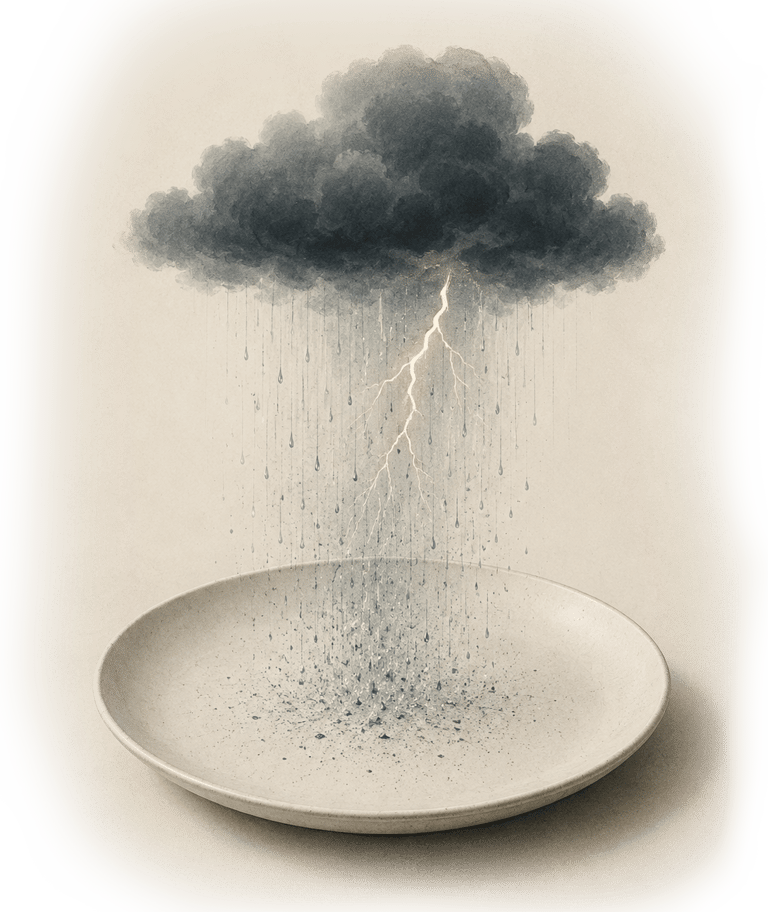
Food has always been a quiet measure of stability. We rarely think about it that way, yet every meal carries within it a long chain of environmental conditions, agricultural systems, labour, and trade. Increasingly, that chain is being disrupted—not in abstract projections of the future, but in the present reality of supermarkets, markets, and household budgets. The climate crisis is no longer a distant environmental issue; it is becoming a direct determinant of what ends up on our plates.
Across Europe and beyond, extreme weather events are reshaping agricultural productivity with growing intensity. Heatwaves, prolonged droughts, unpredictable rainfall, and flooding are no longer anomalies but recurring patterns. According to the Intergovernmental Panel on Climate Change, climate change is already reducing crop yields in several regions and increasing the frequency of simultaneous crop failures, particularly for major staples such as wheat, maize, and rice (IPCC, 2022). At the same time, the European Environment Agency warns that Europe is the fastest-warming continent, with southern regions particularly exposed to water scarcity and agricultural stress (EEA, 2024). These shifts are not only ecological—they are economic and social.
The consequences extend far beyond the fields. When harvests become unstable, global supply chains respond with volatility in prices. The Food and Agriculture Organization has documented repeated spikes in global food price indices in recent years, often linked to climate-related disruptions in production and export capacity (FAO, 2023). Similarly, the World Bank has highlighted how extreme weather events exacerbate food insecurity by simultaneously reducing supply and increasing transportation and production costs (World Bank, 2023). What emerges is a feedback loop: climate instability affects agriculture, agriculture affects prices, and rising prices deepen social vulnerability.
In this context, food becomes a kind of climate archive—recording shifts in temperature, water availability, and ecological stress in real time. A failed harvest in one region can translate into higher prices thousands of kilometres away; a drought season can reshape consumption patterns across entire continents. The World Meteorological Organization has noted that the past decade has been the warmest on record, with increasingly frequent climate extremes affecting all regions of the world (WMO, 2024). The implications for food systems are structural, not temporary.
This article explores that intersection: how extreme weather, agricultural systems, and global food prices are becoming increasingly entangled. It is a story not only about climate science but also about everyday life—about how a warming planet is quietly redefining something as fundamental as what we eat and what we can afford to eat.
Food is becoming a kind of climate archive — recording shifts in temperature, water availability, and ecological stress in real time.
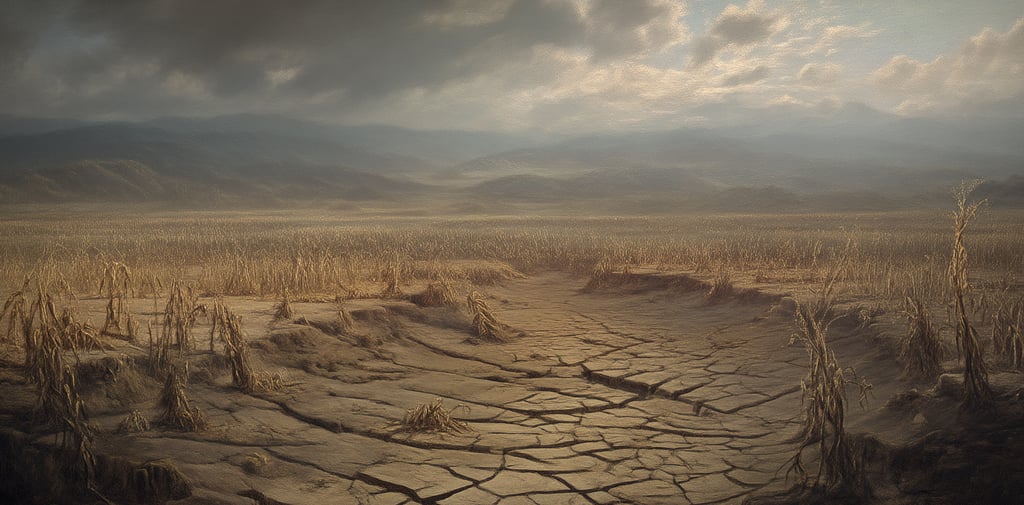
A scorched landscape in the aftermath of prolonged drought — a sight increasingly familiar across agricultural regions in southern Europe and beyond. What once were fields now record the quiet collapse of climatic predictability.
WHEN AGRICULTURE BECOMES CLIMATE-SENSITIVE INFRASTRUCTURE
Modern agriculture is often described as a system of efficiency—maximising yield, stabilising supply, and extending growing seasons through technology and global trade. Yet beneath this apparent stability lies a system deeply dependent on climatic predictability. That predictability is now eroding.
Rising global temperatures are shifting the geographical boundaries of what can be grown, where, and when. The IPCC reports with high confidence that climate change has already reduced agricultural productivity in low-latitude regions, while gains in some higher-latitude areas are increasingly offset by extreme weather and soil degradation (IPCC, 2022). In practice, this means that traditional growing calendars are becoming unreliable. Spring arrives earlier, but late frosts still occur; summers are hotter, but also drier and more volatile.
Europe illustrates this tension clearly. Southern regions such as Spain, Italy, and Greece are experiencing more frequent and prolonged droughts, placing pressure on water-intensive crops such as olives, grapes, and vegetables. The European Environment Agency notes that water scarcity is already affecting a significant portion of the EU’s territory and is expected to intensify under current warming trajectories (EEA, 2024). Meanwhile, northern regions face increased rainfall variability and flooding, disrupting planting and harvest cycles rather than simply extending them.
Beyond temperature and rainfall, soil health is becoming a central concern. The FAO has long warned that soil degradation—accelerated by erosion, drought, and unsustainable land use—directly threatens global food security (FAO, 2022). When soils lose organic matter and moisture retention capacity, even normal weather patterns can produce reduced yields. In other words, climate change does not only bring extremes; it weakens the baseline conditions that agriculture depends on.
At a global scale, this instability becomes systemic. The World Meteorological Organization has documented an increase in concurrent climate extremes affecting multiple major food-producing regions at the same time (WMO, 2024). This is particularly significant: when disruptions occur simultaneously across different “breadbaskets” of the world, global trade can no longer fully compensate. The idea of food security shifts from abundance to fragility.
What emerges is a fundamental shift in agriculture’s identity. It is no longer simply a productive sector shaped by economic efficiency and technological innovation. It is becoming climate-sensitive infrastructure—exposed, adaptive, and increasingly unpredictable. And as this instability deepens, its effects do not remain in the fields. They travel further down the chain into logistics, markets, and, ultimately, into the price of food itself.
FROM FIELD TO INFLATION: HOW CLIMATE BECOMES PRICE
For decades, food inflation was largely understood through the lens of economics: energy prices, labour shortages, geopolitical instability, or fluctuations in global trade. Increasingly, however, climate change is becoming one of the underlying forces reshaping the economics of food itself. The connection between extreme weather and supermarket prices is no longer indirect—it is structural.
Agriculture operates within narrow climatic margins. A few weeks of drought, an unexpected frost, or prolonged flooding during harvest season can significantly reduce yields and destabilise supply chains. In recent years, these disruptions have become more frequent across multiple agricultural regions simultaneously. According to the Food and Agriculture Organization, climate-related shocks are now among the primary drivers of volatility in global food commodity markets (FAO, 2023). The result is a system where environmental instability increasingly translates into economic instability.
This relationship became particularly visible across Europe during the severe droughts of recent summers. In Spain—one of the continent’s largest producers of olives and vegetables—extended periods of heat and water scarcity led to dramatic declines in olive harvests, contributing to record increases in olive oil prices across European markets (Reuters, 2024). Similar patterns have emerged in coffee and cocoa production globally. Extreme heat, irregular rainfall, and crop disease have affected yields in major producing regions such as Brazil, Vietnam, and West Africa, pushing prices upward and exposing the fragility of globally concentrated food systems (Financial Times, 2024).
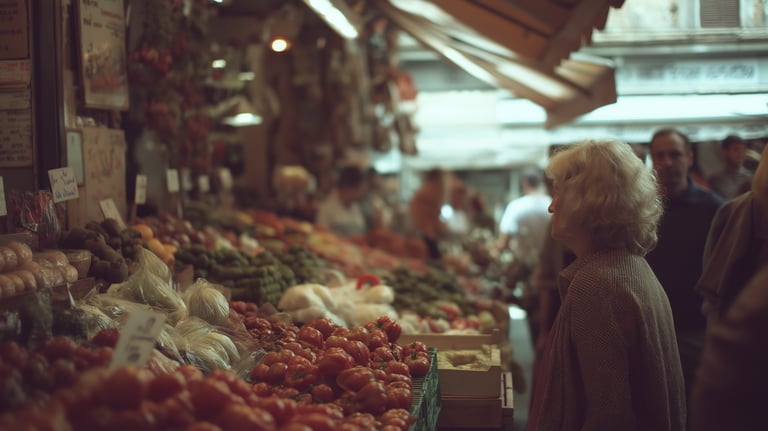
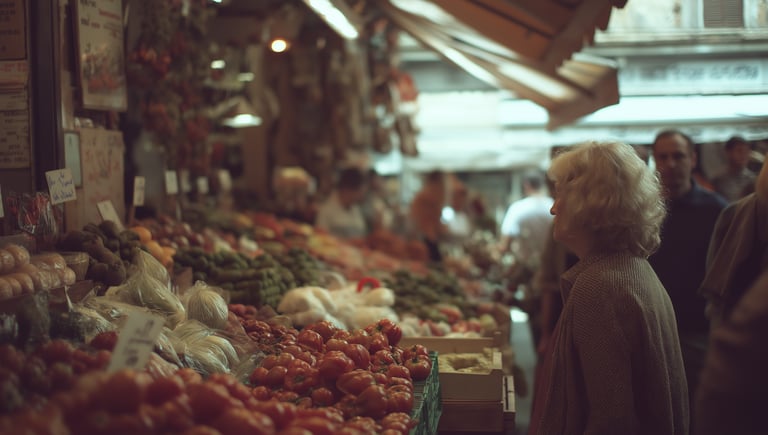
An elderly woman surveys the market stalls — a scene repeated across European cities every day. Behind the abundance of colour and produce lies a quieter reality: rising prices, shrinking choices, and the slow pressure of a changing climate reaching into the most ordinary of routines.
What makes climate-driven inflation especially complex is that it rarely affects only one stage of production. Heatwaves increase irrigation needs and energy consumption; droughts reduce livestock feed availability; flooding damages infrastructure and transport networks. Each disruption accumulates along the supply chain. The World Bank has warned that climate change acts as a “threat multiplier” within food systems, amplifying existing vulnerabilities related to energy, trade, and inequality (World Bank, 2023).
The consequences are deeply uneven. Higher-income households may absorb rising food prices as an inconvenience, but for lower-income populations, food inflation quickly becomes a social crisis. Eurostat data shows that food costs have become one of the most persistent contributors to inflationary pressure across the European Union in recent years (Eurostat, 2024). As essential goods become more expensive, climate change begins to reshape not only economies but also patterns of consumption, nutrition, and public health.
In this sense, the era of consistently cheap and predictable food may be coming to an end. Industrial agriculture and globalised logistics once created the illusion that seasonality, geography, and climate could be largely overcome through efficiency and scale. Yet climate instability is exposing the limits of that model. The question is no longer whether climate change affects food prices but how societies will adapt to a future in which environmental volatility becomes economically permanent.
Food inflation, then, is not merely a temporary market fluctuation. It is increasingly a climate signal—one that reveals how deeply ecological systems and everyday life have become intertwined.
The era of consistently cheap and predictable food may be coming to an end.
THE DISAPPEARING LOGIC OF THE SEASONS
For much of modern urban life, food has appeared detached from seasonality. Supermarkets created the illusion of permanence: strawberries in winter, tomatoes in early spring, avocados year-round. Global trade and industrial agriculture transformed food into something constantly available, largely disconnected from climate, geography, or natural rhythms. Yet the climate crisis is beginning to fracture that illusion.
Seasonality is no longer changing gradually; it is becoming increasingly unstable. Across Europe, farmers are facing growing uncertainty around planting and harvesting cycles. Warmer winters trigger earlier blooming periods, only for late frosts to destroy vulnerable crops weeks later. In France and Italy, vineyards have suffered repeated frost damage following unusually warm early springs, while Mediterranean producers face mounting losses linked to prolonged drought and extreme heat (European Commission, 2024). The problem is not simply warming itself but unpredictability.
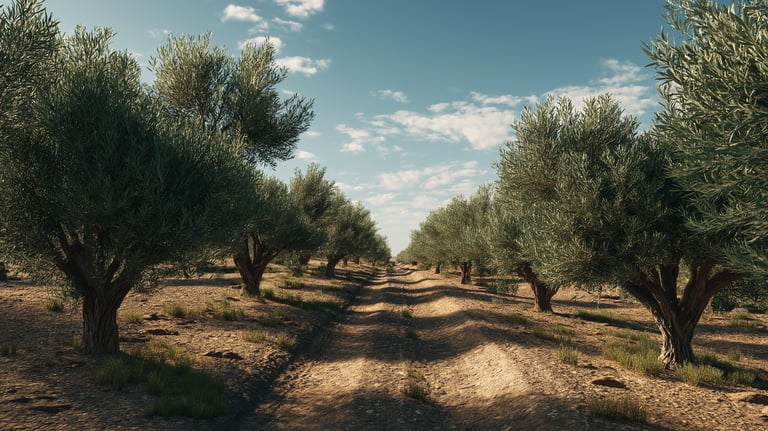
Olive groves have shaped the Mediterranean landscape for millennia — but consecutive drought seasons across Spain, Italy, and Greece are placing these ancient trees under unprecedented stress. What was once a stable harvest is becoming an increasingly fragile one.
This instability alters more than agricultural output—it reshapes the cultural meaning of food. Certain products become scarce, more expensive, or increasingly difficult to cultivate within traditional regions. Olive oil prices across Europe reached historic highs following consecutive drought seasons in southern Europe, while fruit and vegetable harvests have become increasingly volatile (Reuters, 2024). Foods once considered ordinary staples are slowly acquiring the fragility of seasonal luxuries.
The effects are particularly visible in products deeply tied to climate-sensitive ecosystems. Coffee production faces significant long-term risks from rising temperatures and shifting rainfall patterns, especially in Latin America and East Africa. Research published in Nature Climate Change suggests that many current coffee-growing regions may become substantially less suitable by mid-century without significant adaptation measures (Bunn et al., 2015). Cocoa production faces similar pressures in West Africa, where heat stress and irregular precipitation threaten both yields and farmer livelihoods (UNCTAD, 2024). What is at stake is not only supply but also cultural continuity: foods and drinks embedded within everyday rituals may become increasingly unstable or inaccessible.
At the same time, climate change is intensifying debates around localism and food sovereignty. As global supply chains become more vulnerable to environmental disruption, countries across Europe are reconsidering the resilience of highly import-dependent food systems. The pandemic and the energy crisis already exposed logistical fragilities; climate volatility deepens them further. In this context, local agriculture is no longer framed solely as an ethical or environmental preference but increasingly as a strategic necessity.
Yet even local systems remain exposed. Bulgaria, like many countries in southeastern Europe, faces rising risks linked to drought, water scarcity, soil degradation, and depopulation in rural regions. According to the European Environment Agency, southeastern Europe is among the continent’s most climate-vulnerable areas, particularly regarding agricultural productivity and water stress (EEA, 2024). The future of food, therefore, cannot be reduced to a simple return to “local” or “organic” solutions. The scale of climate disruption is systemic.
What emerges instead is a growing awareness that food is inseparable from ecological stability. The climate crisis is forcing societies to confront a reality long obscured by abundance and globalisation: every agricultural system ultimately depends on predictable seasons, healthy soil, and stable water cycles. As those conditions become less reliable, food itself becomes a record of environmental change—an everyday reminder that climate is no longer a distant backdrop to human life but an active force shaping it.
Food inflation is not merely a temporary market fluctuation. It is increasingly a climate signal.
RETHINKING SUSTAINABILITY IN AN AGE OF FOOD INSECURITY
For years, sustainability has often been presented through the language of lifestyle: reusable packaging, ethical consumption, organic labels, and individual responsibility. While these conversations remain important, the climate crisis is increasingly revealing a deeper and more uncomfortable reality. Sustainability is no longer simply about consuming “better”. It is becoming a question of resilience, access, and survival.
Food sits at the centre of this shift. As climate instability intensifies, the ability to produce affordable and reliable food can no longer be taken for granted. What once appeared as an issue of environmental ethics is rapidly becoming an issue of economic and social stability. The climate crisis does not affect all populations equally, and neither does food insecurity. According to the United Nations, rising food prices disproportionately impact lower-income households, which spend a larger percentage of their income on essential goods (UN DESA, 2023). In this sense, climate change magnifies existing inequalities through something profoundly everyday: eating.
This also exposes the limitations of a food culture shaped by abundance and convenience. Over recent decades, industrial agriculture and global logistics created a system designed around constant availability, low prices, and speed. Consumers grew accustomed to full supermarket shelves regardless of season or geography. Yet the environmental cost of this model—soil depletion, water overuse, biodiversity loss, and carbon-intensive transport—has become increasingly visible. The climate crisis is not external to the modern food system; it is partly produced by it.
Agriculture itself contributes significantly to global greenhouse gas emissions, particularly through industrial livestock production, fertiliser use, and land-use change. The IPCC estimates that food systems account for roughly one-third of global anthropogenic emissions (IPCC, 2022). This creates a paradox at the heart of the climate crisis: the very systems designed to feed a growing global population are simultaneously intensifying the environmental instability that threatens future food production.
In response, conversations around sustainability are beginning to shift from efficiency to resilience. Concepts such as regenerative agriculture, shorter supply chains, water-conscious farming, and biodiversity restoration are increasingly framed not as alternatives, but as necessities. Across Europe, policymakers and environmental researchers are emphasising the need to redesign food systems around long-term ecological stability rather than short-term productivity alone (EEA, 2024). The challenge is immense, particularly in a global economy still structured around growth, extraction, and consumption.
Yet beyond policy and economics lies a more cultural transformation. The climate crisis is forcing societies to reconsider their relationship with food itself—not merely as a product or commodity but as something fundamentally tied to land, seasons, labour, and ecological balance. In a warming world, food becomes more than nourishment. It becomes evidence of environmental change, vulnerability, and interdependence.
Perhaps this is the most unsettling aspect of the climate crisis: its ability to transform ordinary experiences into reminders of planetary instability. A failed harvest, a rising grocery bill, an absent seasonal fruit—these are not isolated inconveniences, but fragments of a larger ecological reality unfolding in everyday life. The climate on our plates is no longer metaphorical. It is material, economic, and increasingly impossible to ignore.
The climate on our plates is no longer metaphorical. It is material, economic, and increasingly impossible to ignore.
FOOD, INEQUALITY, AND CLIMATE VULNERABILITY
The climate crisis does not arrive equally. While rising food prices are increasingly felt across Europe and other affluent regions, the heaviest consequences continue to fall on populations already living within conditions of economic and environmental vulnerability. In many parts of the world, climate change is not merely altering diets or increasing grocery bills—it is threatening livelihoods, political stability, and access to basic survival.
Agriculture remains a primary source of income for billions of people globally, particularly across parts of Africa, South Asia, and Latin America. Yet many of these regions are also among the most exposed to extreme heat, drought, desertification, and water scarcity. According to the United Nations Food and Agriculture Organization, climate-related disasters have caused billions of dollars in agricultural losses over recent decades, disproportionately affecting small-scale farmers and low-income rural communities (FAO, 2023). These losses extend beyond economics; they destabilise entire social systems built around land and seasonal predictability.
The relationship between climate and food insecurity is increasingly linked to migration and political instability. The World Food Programme has repeatedly warned that prolonged droughts, crop failures, and resource scarcity intensify displacement and conflict risks, particularly in already fragile regions (WFP, 2024). In this context, food becomes more than a commodity—it becomes a geopolitical pressure point.
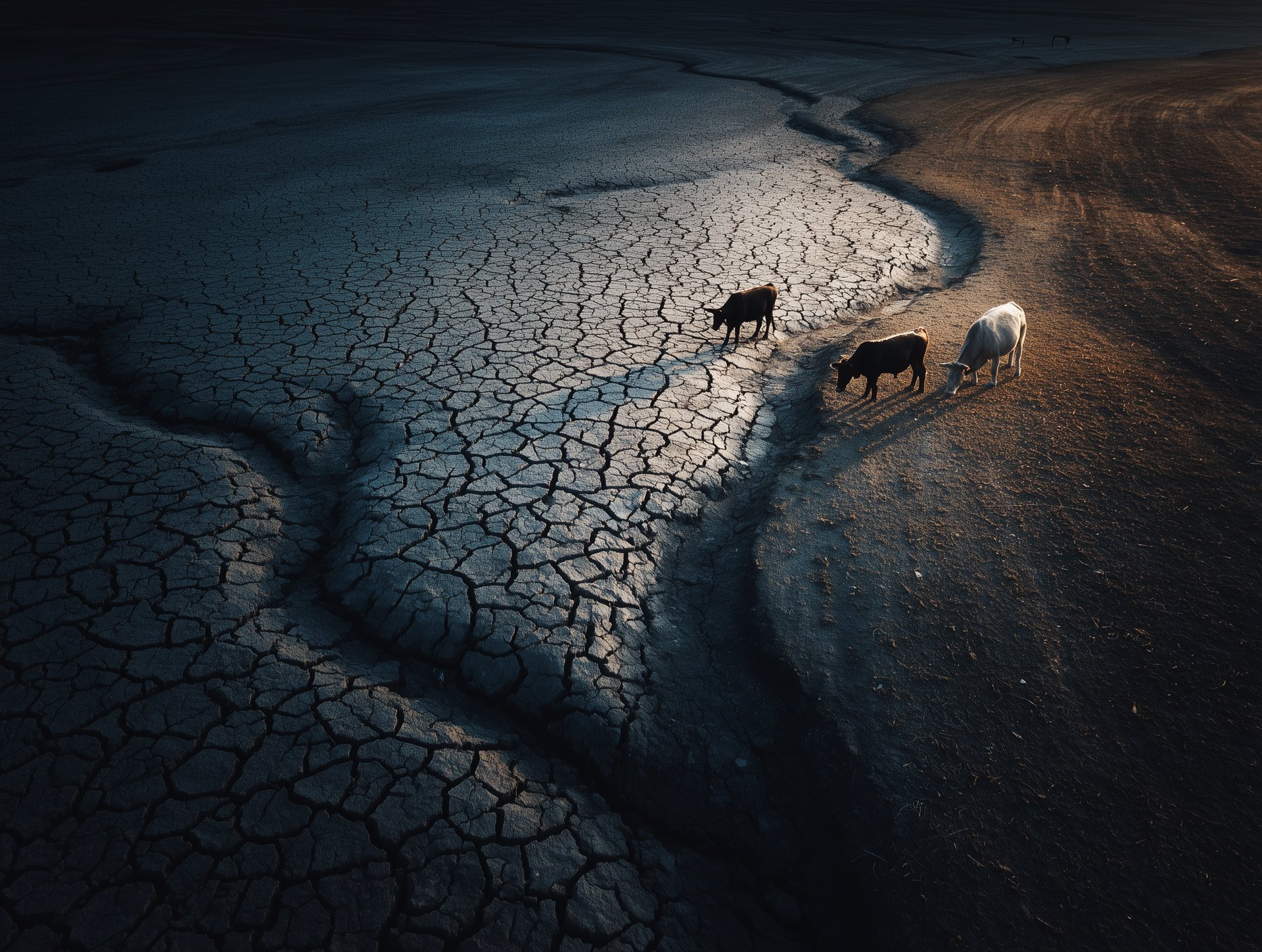
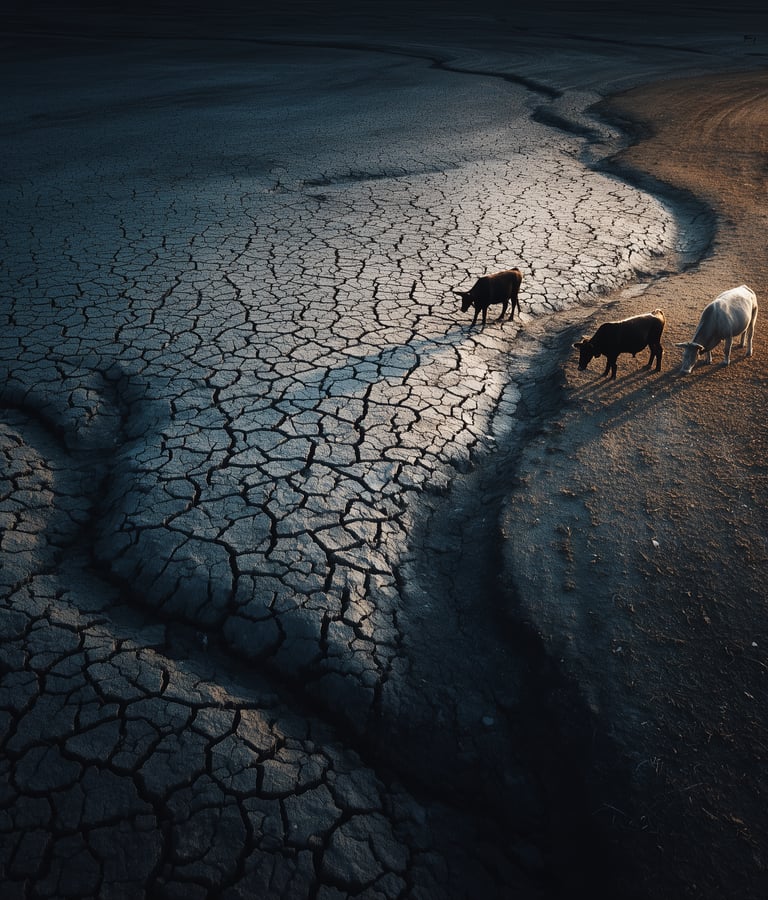
Livestock navigate the boundary between cracked earth and barren ground — an aerial view that captures the quiet desperation of drought-stricken agricultural land. For millions of farmers globally, this is not a photograph of crisis. It is the new ordinary.
Recent years have demonstrated how interconnected global food systems truly are. Disruptions in one region rapidly cascade across international markets. The war in Ukraine exposed the vulnerability of global grain supply chains, particularly for countries heavily dependent on imported wheat and fertilisers. Simultaneously, climate-related shocks in major producing regions have amplified volatility in global markets. Export restrictions, price spikes, and shortages increasingly reveal the fragility of a system dependent on continuous stability.
This fragility also challenges long-standing assumptions about globalisation. For decades, international trade functioned as a buffer against regional crop failures: poor harvests in one area could be offset by production elsewhere. But climate change is increasing the likelihood of simultaneous disruptions across multiple agricultural regions at once. As the World Meteorological Organization notes, concurrent climate extremes are becoming more frequent under warming conditions (WMO, 2024). The consequence is a world where resilience can no longer rely solely on geographic diversification.
At the same time, climate vulnerability remains deeply unequal within wealthy societies themselves. Food inflation affects all consumers, but not equally. Lower-income households spend a far greater share of their income on essentials, making them disproportionately exposed to rising costs. In this sense, the climate crisis reshapes inequality not only through dramatic disasters but also through the slow pressure of everyday expenses.
Food therefore emerges as one of the clearest intersections between ecology, economics, and justice. It reveals how environmental crises move through social structures, exposing inequalities that long predate climate change itself. The warming planet does not create vulnerability from nothing—it intensifies existing fragilities, making the future of food inseparable from the future of social stability.
CONCLUSION
The climate crisis is often discussed through statistics, projections, and distant timelines. Yet some of its most profound consequences unfold quietly through ordinary routines that once felt stable and unquestioned. Food is one of them. What we eat, how much it costs, where it comes from, and whether it remains reliably available are increasingly shaped by a planet entering a state of environmental instability.
For decades, industrial agriculture and global trade created the impression that food systems existed outside the limits of nature—that technology, logistics, and economic growth could indefinitely overcome seasonality, geography, and ecological constraint. But the return of droughts, crop failures, water scarcity, and price volatility reveals a different reality. Human systems remain deeply dependent on climatic balance, even when modern life attempts to obscure that dependence.
The significance of this shift extends beyond economics or agriculture alone. Food carries cultural memory, social identity, and emotional familiarity. Seasons have historically shaped not only harvests but also rituals, traditions, and everyday rhythms of life. As climate instability accelerates, it also disrupts this quieter relationship between people and the natural world. The disappearance of predictability alters not only markets but also perceptions of normality itself.
At the same time, the climate crisis exposes a growing contradiction at the heart of contemporary society: a global economy built on endless consumption confronting ecological systems that are increasingly unable to sustain it. The pressure placed on land, water, and food production is no longer theoretical. It is visible in rising grocery bills, stressed agricultural regions, and the fragility of supply chains that once appeared permanent.
Perhaps this is why food has become one of the clearest ways to understand the climate crisis. It transforms an abstract planetary phenomenon into something immediate, intimate, and impossible to ignore. Climate change is no longer confined to scientific reports or environmental discourse. It appears at markets, in kitchens, across fields, and on supermarket shelves. It becomes part of daily life.
The climate on our plates is therefore not simply a metaphor. It is a reflection of a changing world — one in which the future of food, stability, and everyday life will increasingly depend on the fragile relationship between human systems and the environment that sustains them. The question is no longer whether that relationship is breaking down but how far it must fracture before the systems we rely on begin to change in kind. What we choose to put on our plates today — and what we choose to demand from those who shape the food system — may be one of the few meaningful places where individual life and planetary future still intersect. The climate is already on our plates. The only question left is whether we are ready to taste it.
References
Bunn, C., Läderach, P., Ovalle Rivera, O. and Kirschke, D. (2015) ‘A bitter cup: climate change profile of global production of Arabica and Robusta coffee’, Climatic Change, 129(1–2), pp. 89–101.
European Environment Agency (2024) European Climate Risk Assessment. Luxembourg: Publications Office of the European Union.
European Commission (2024) Climate impacts on European agriculture and rural areas. Brussels: European Commission Directorate-General for Agriculture and Rural Development.
Eurostat (2024). Food inflation in the European Union: recent trends and economic impacts. Luxembourg: European Commission.
Food and Agriculture Organization of the United Nations (FAO) (2022) The State of the World’s Land and Water Resources for Food and Agriculture – Systems at Breaking Point. Rome: FAO.
Food and Agriculture Organization of the United Nations (FAO) (2023). The State of Food Security and Nutrition in the World 2023. Rome: FAO.
Intergovernmental Panel on Climate Change (IPCC) (2022) Climate Change 2022: Impacts, Adaptation and Vulnerability. Contribution of Working Group II to the Sixth Assessment Report of the Intergovernmental Panel on Climate Change. Cambridge: Cambridge University Press.
Reuters (2024) ‘Olive oil prices surge across Europe after severe drought damages harvests in Spain’. Available at: Reuters (Accessed: 18 May 2026).
Financial Times (2024). ‘Climate pressures drive volatility in coffee and cocoa markets.’ Available at: Financial Times (Accessed: 18 May 2026).
United Nations Conference on Trade and Development (UNCTAD) (2024) Global trade and climate vulnerabilities in agricultural commodities. Geneva: United Nations.
United Nations Department of Economic and Social Affairs (UN DESA) (2023) World Social Report 2023: Leaving No One Behind in an Ageing World. New York: United Nations.
World Bank (2023) Climate and Development Report: Food Systems, Climate, and Poverty. Washington, DC: World Bank.
World Food Programme (WFP) (2024) Climate crises and global food insecurity. Rome: United Nations World Food Programme.
World Meteorological Organization (WMO) (2024) State of the Global Climate 2024. Geneva: WMO.