PANKRATION, PANIC, AND THE FRAGILE ILLUSION OF CONTROL

PAN
The body where identity breaks
The body was our first language.
Before representation, before naming, before identity, the body existed as a fact.
My interest in how bodies communicate meaning began early, during my education at an art school, where the human figure was never treated as a neutral form. Anatomy was not merely structure; it was tension, intention, vulnerability. A torso could imply power or fragility. A posture could suggest discipline, desire, or fear. Later, this fascination deepened through translated critical texts in Bulgarian periodicals, most notably the writings of Igor Semyonovich Kon, whose work challenged the notion of the male body as a natural given. His examination of male corporeality across cultural history encouraged me to understand masculinity not as a fixed biological inheritance, but as something shaped, interpreted, and negotiated through social expectations (Kon, 2003). Masculinity, viewed through this lens, is not simply inherited; it is constructed, rehearsed, and constantly tested.
This perspective becomes particularly revealing when viewed through the lens of antiquity — not the polished antiquity of marble statues and ideal proportions, but one marked by struggle, exposure, and risk. Among ancient Greek athletic practices, pankration stands apart. Combining wrestling and striking, it was a combat discipline governed by relatively few restrictions and characterised by intense physical demands. Embedded within the competitive culture of ancient Greece, pankration belonged to the tradition of the agōn — a contest in which victory depended upon physical skill, endurance, and the opponent’s submission (Poliakoff, 1987). Yet beneath its public spectacle lay a different reality: a body confronted with its own limits. The preservation of an idealised image gave way to the urgency of physical response.
It is here that Pan (Πάν) enters — not as a decorative mythological figure, but as an archetype of rupture. Associated with wilderness and sudden, overwhelming fear, Pan embodies an unsettling proximity between the familiar and the unpredictable. His hybrid anatomy occupies a threshold between human and animal, while his mythological associations evoke the boundaries between civilisation and wilderness (Borgeaud, 1988). Read within the broader cultural framework explored by Jean-Pierre Vernant, Greek mythology offers a means of thinking through the tensions that structure human experience (Vernant, 1983). Within this essay, Pan becomes the embodiment of one such tension: the possibility that order may dissolve precisely where it appears most secure.
This article is neither an exercise in mythological analysis nor a historical account of an ancient sport. Instead, it uses pankration as a conceptual framework and Pan as a philosophical pressure point to ask a contemporary question: what remains of identity when the image fails? In a culture where bodies are endlessly visualised, curated, and disciplined — through fitness regimes, wellness ideologies, and digital representation — the ancient combat arena exposes an uncomfortable tension. Beneath identity as narrative and art as form, there persists a body whose material reality cannot be fully contained by either.
I. PANKRATION AND THE REFUSAL OF THE IMAGE
In classical art, the body is resolved.
In pankration, it is interrupted.
Much of the Western reception of classical Greek sculpture has privileged an image of the male body as balanced, proportioned, and seemingly self-contained. Even in moments of tension, the sculpted figure can appear arrested in an intelligible arrangement of movement and form. This visual inheritance has profoundly shaped Western ideas of bodily perfection, sustaining the belief that physical harmony is both desirable and attainable. Yet antiquity itself offers a more complex picture. The bruised face, wounded flesh, and exhausted posture of The Boxer at Rest remind us that the ancient artistic imagination was equally capable of recognising the vulnerability of the trained body. The ideal and its disruption belong to the same cultural history.
Pankration occupies the space between them. Although combat itself was represented in ancient art, its lived experience cannot be contained within the logic of representation. Under physical pressure, symmetry becomes incidental. The body folds, contorts, and struggles to recover its balance. What matters to the fighter is not the visual coherence of the posture, but its immediate effectiveness. The distinction is not between a body that can be represented and one that cannot, but between the body as an object of perception and the body as a condition of experience (Poliakoff, 1987).
This distinction becomes particularly revealing through Richard Neer’s interpretation of classical Greek sculpture. Rather than understanding classical form primarily as a pursuit of naturalism or perfection, Neer emphasises its capacity to produce wonder and to establish a compelling relationship between the sculptural object and its beholder (Neer, 2010). In pankration, however, the centre of experience shifts. The body may continue to command the attention of spectators, but for the fighter, its significance is immediate and internal. What the spectator perceives as movement, strength, or vulnerability is experienced from within as effort, resistance, and uncertainty. The same body inhabits two fundamentally different realities.
Such moments raise a deeper question about identity. When the body approaches its physical limits, the symbolic frameworks through which the self is ordinarily understood — status, reputation, appearance — may temporarily lose their immediacy. Michel Foucault’s analysis of bodily discipline offers a useful conceptual framework for understanding this tension. Discipline produces bodily capacities while simultaneously rendering them subject to systems of regulation (Foucault, 1977). Applied here as an interpretative lens rather than a historical equivalence, his argument illuminates a paradox: the trained body may acquire remarkable strength and precision without becoming entirely predictable. Discipline expands the possibilities of action; it does not eliminate vulnerability.
Pan’s presence is felt precisely here — not as a figure watching from the margins, but as a force emerging from within the experience of the body itself. He occupies the distance between intention and response, between what the body has been trained to do and what it is momentarily capable of doing. His presence becomes perceptible when conscious mastery encounters its limits. What is interrupted is not identity itself, but the certainty with which it is inhabited.
For contemporary viewers, this refusal of the image resonates powerfully. Today’s visual culture demands consistency, optimisation, and legibility. Bodies are curated through training, mediated through screens, and disciplined into recognisable forms of identity. Yet practices that foreground exhaustion, impact, and physical risk — whether in combat sports or performance art — reveal an aspect of corporeality that visual representation can acknowledge but never fully reproduce. They bring us closer to the distinction between appearing vulnerable and experiencing vulnerability.
Pankration reminds us that the body always exceeds its representation. Before it can be held in an image or interpreted through a narrative, it must be lived. This is not a nostalgic return to antiquity, but a confrontation with something unresolved in the present: the possibility that the body through which we construct our identity may also become the very condition that unsettles it.


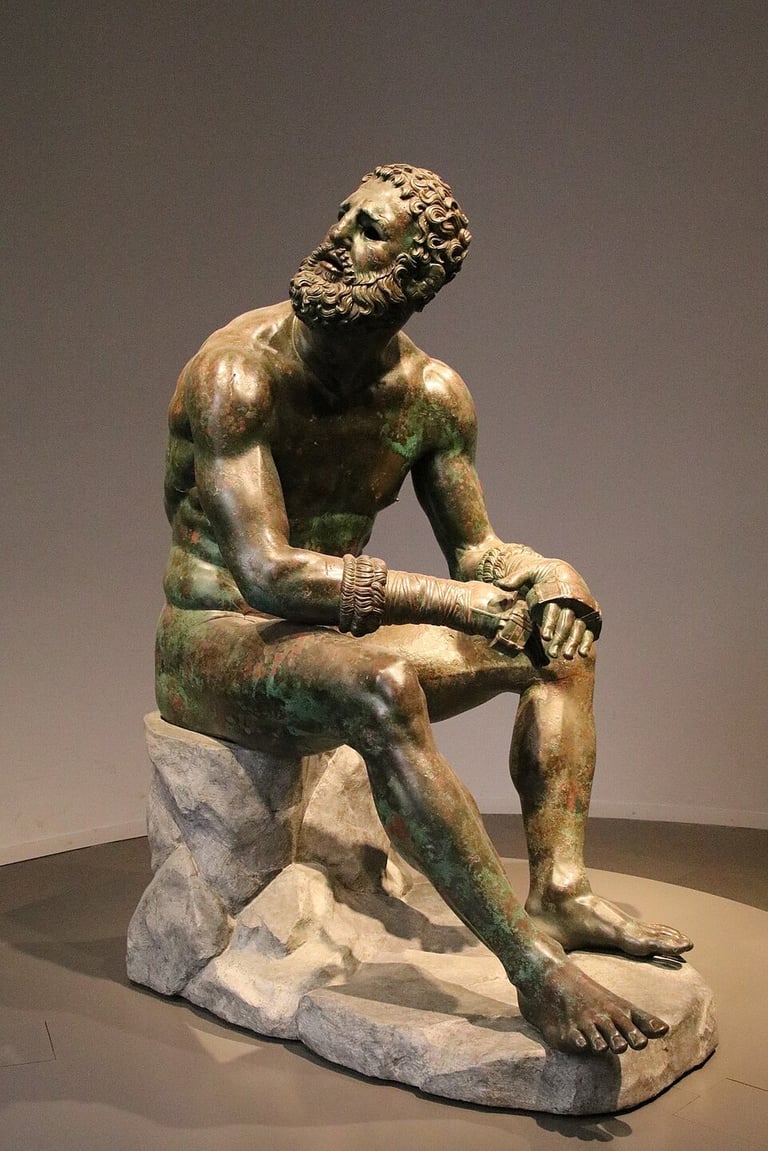

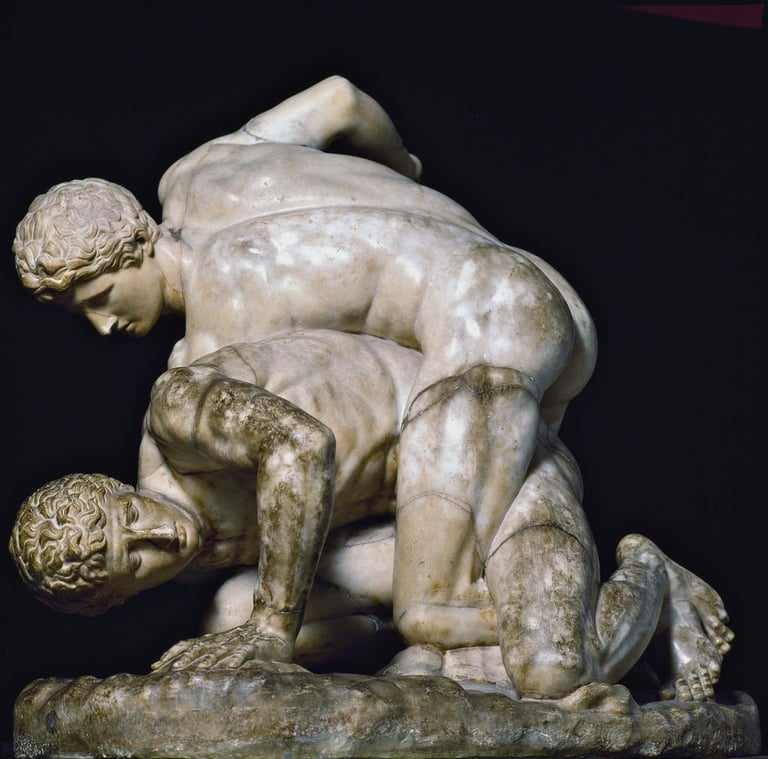


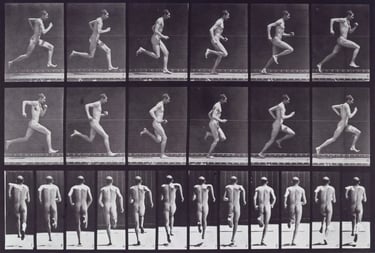


Fig. 1. Boxer at Rest (also known as the Terme Boxer), Hellenistic Greek bronze, late 4th–2nd century BCE.
Fig. 2. Euphronios (painter) and Euxitheos (potter), Sarpedon Krater, c. 515 BCE.
Fig. 3. Wrestlers (Uffizi Wrestlers), Roman marble sculpture, 1st century CE.
Fig. 4. Eadweard Muybridge, Running, from Animal Locomotion, 1887.
Fig. 5. Michelangelo Buonarroti, Male Nude, Seen from the Rear (verso), study for the Battle of Cascina, c. 1504.
Fig. 6. Francis Bacon, Two Figures, 1953.
II. PAN, PANIC, AND THE BODY BEYOND CONTROL
Panic is not imagined.
It is felt.
The association between Pan and panic preserves an ancient understanding of fear as something capable of overwhelming both individual judgement and collective order. In Greek accounts, panic could descend suddenly upon groups of people, disrupting their ability to recognise danger, communicate, or respond coherently. What makes this experience particularly unsettling is the distance between sensation and understanding. The body may already be responding to a threat before the nature of that threat becomes clear.
In ancient Greek religious imagination, Pan was closely associated with landscapes beyond the immediate order of the polis — mountains, forests, caves, and pastoral territories. His hybrid anatomy unsettles familiar categories, bringing human and animal attributes into a single divine figure. Yet his significance extends beyond the apparent opposition between civilisation and wilderness. In his study of the cult of Pan, Philippe Borgeaud distinguishes between collective panic and individual possession, or panolepsy (Borgeaud, 1988, pp. 88–116). Both involve a disturbance of ordinary experience, whether through the breakdown of communication within a group or the disruption of an individual’s relationship with the self. What becomes uncertain is not simply the presence of danger, but one’s place within a familiar world.
Pankration provides a physical setting in which a comparable uncertainty can emerge. The fighter enters the contest trained, disciplined, and prepared, yet preparation cannot anticipate every bodily response. Breathing may become difficult, balance may falter, and pain may interrupt concentration. Under such conditions, the body ceases to appear as a transparent instrument of conscious intention. It becomes something with which the self must negotiate. The unsettling possibility is that the body can remain profoundly our own while no longer responding in ways we recognise or expect.
The tension between intention and impulse also finds expression in ancient philosophy. In Plato’s Phaedrus, the allegory of the charioteer and the two horses presents the soul as a dynamic arrangement of competing forces requiring guidance and negotiation (Plato, 2005, 246a–254e). Yet Plato’s account of divine madness complicates any straightforward opposition between rational order and irrational experience. Not every departure from conscious mastery represents a deficiency. Read alongside this philosophical tradition, Pan becomes a figure through whom we might reconsider the assumption that selfhood depends upon the uninterrupted authority of reason.
Contemporary cultural theory offers another way of approaching this uncertainty. In Parables for the Virtual, Brian Massumi develops an understanding of affect that draws attention to dimensions of bodily experience not exhausted by conscious recognition or linguistic expression (Massumi, 2002). Applied to the experience of panic, this perspective invites us to consider the interval between what is felt and what can be understood. The significance of panic, in this context, is not that it exists beyond explanation, but that explanation does not necessarily arrive at the same moment as sensation. The experience may precede the language through which we attempt to make sense of it.
This is why Pan remains unsettling. He does not need to destroy order to expose its fragility. A moment of hesitation, an unfamiliar bodily response, or a sudden loss of orientation may be enough to interrupt the continuity through which the self is ordinarily experienced. Panic, in this philosophical reading, does not disclose a more authentic identity hidden beneath conscious life. Rather, it reveals the instability of the relationship between bodily experience and our understanding of ourselves.
To encounter Pan, then, is to encounter a rupture in certainty. It is to recognise that the body through which we experience the world is never entirely reducible to the intentions we impose upon it. What emerges in that moment is not the absence of identity, but an awareness of its dependence upon conditions we cannot always command. Pan names the unsettling experience of becoming unfamiliar to oneself.
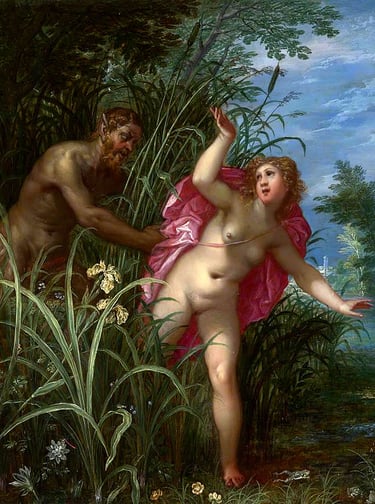

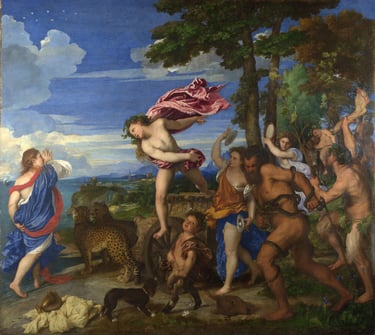

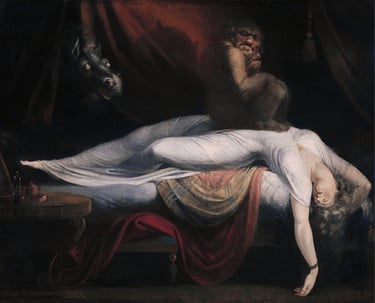


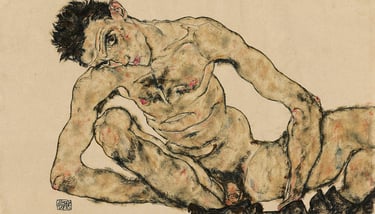


Fig. 7. Hendrick van Balen the Elder and follower of Jan Brueghel the Elder, Pan pursuing Syrinx, possibly after 1615. Fig. 8. Titian (Tiziano Vecellio), Bacchus and Ariadne, 1520–1523. Fig. 9. Henry Fuseli, The Nightmare, 1781. Fig. 10. Egon Schiele, Nude Self-portrait, Squatting, 1916. Fig. 11. Francis Bacon, Study after Velázquez’s Portrait of Pope Innocent X, 1953.
III. COMBAT, RITUAL, AND THE CONTEMPORARY BODY
Combat is more than a contest.
It is a ritual of exposure.
In antiquity, athletic contests were embedded within religious, civic, and competitive frameworks. Pankration brought these dimensions together through an encounter in which the trained body was publicly subjected to physical uncertainty. Victory carried considerable cultural significance, yet the experience of combat extended beyond its outcome. The arena became a space in which strength, endurance, and vulnerability were made visible to others (Poliakoff, 1987). The body entered not merely as an instrument of competition, but as the material through which personal achievement and collective expectations were negotiated.
The anthropologist Victor Turner’s concept of liminality offers a useful framework for interpreting this experience. In The Ritual Process, Turner examines transitional states in which established social positions become temporarily uncertain (Turner, 1969). Although pankration cannot simply be classified as a rite of passage, it can be read through this notion of the threshold. Within the arena, reputation does not guarantee physical mastery, and the identities carried into the contest remain subject to its unpredictable conditions. The body occupies an interval between what society expects of it and what its material capacities allow. For the male athlete, this interval is particularly revealing: the cultural expectation of strength becomes inseparable from the possibility of vulnerability.
A comparable tension emerges within contemporary body-centred art. Throughout the twentieth and twenty-first centuries, artists have explored endurance, exposure, and physical risk as artistic material. Rather than presenting the body exclusively through its representation, these practices make bodily experience part of the work itself. Amelia Jones’s analysis of body art challenges the notion of the autonomous artistic subject, drawing attention to the relationships through which embodied identity is experienced and interpreted (Jones, 1998). The meaning of the work is therefore not confined to the artist’s intention; it also emerges through the encounter between the performing body and those who observe it.
Marina Abramović’s Rhythm 0 (1974) exposes the ethical instability of this encounter. By remaining passive for six hours and allowing the audience to interact with her body, Abramović made the behaviour of the spectators an integral part of the performance (Irish Museum of Modern Art, n.d.). Her vulnerability was not simply represented; it became the condition through which the work unfolded. The distinction between observing and participating was deliberately unsettled, raising a question that extends beyond the gallery: what responsibility does the spectator assume when another person’s body becomes the object of attention?
Santiago Sierra’s 160 cm Line Tattooed on 4 People (2000) introduces a different dimension of bodily exposure. In this work, four economically vulnerable women were paid to participate in a permanent alteration of their bodies (Dizdar, 2019). Here, the question of control cannot be separated from the conditions under which consent is negotiated. The body becomes a site where economic power acquires a physical form. The work does not simply ask what a body can endure, but who determines the circumstances of that endurance, and whose vulnerability becomes available for cultural consumption.
These questions resonate with the contemporary commercialisation of combat. Regulated sporting events and their mediated representations transform physical confrontation into a consumable experience. Training, rules, and safety protocols establish boundaries around risk, while the visual narratives surrounding competition frequently privilege strength, determination, and masculine resilience. Yet the uncertainty of the encounter remains essential to its appeal. The spectator anticipates a display of mastery while simultaneously witnessing the possibility of its interruption. Vulnerability becomes both a genuine physical condition and a source of commercial value.
Here, Pan returns as the unresolved element within an organised encounter. His presence does not signify the absence of rules, but the impossibility of making their outcomes entirely predictable. Every structure that frames bodily exposure — the athletic arena, the gallery, the commercial spectacle — establishes conditions under which uncertainty can be approached, observed, and sometimes exploited. None can guarantee that the body will remain within the meanings assigned to it.
Ritual, then, does not resolve the instability of the body; it gives that instability a social form. Combat and performance art are not equivalent practices, yet both illuminate the complex relationship between discipline, exposure, and spectatorship. They remind us that vulnerability is never entirely private once it becomes visible to others. The question is no longer simply whether the body can be mastered, but what happens when its limits become something for others to witness, interpret, or consume.




In Rhythm 0, Marina Abramović transformed spectatorship into an ethical encounter. By assuming a deliberately passive role, she exposed the unstable relationship between permission, responsibility, and power. The photograph preserves a moment in which the body becomes the focus of actions directed by others, while the boundary between observation and participation begins to dissolve. Unlike the athletic contest, where vulnerability is negotiated through reciprocal action and established rules, Abramović’s performance confronts the consequences of profoundly unequal agency. The question is not simply what the body can endure, but what the spectator is willing to permit.
Fig. 12. Foundry Painter (attributed), Attic red-figure kylix depicting pankration, c. 490–480 BCE.
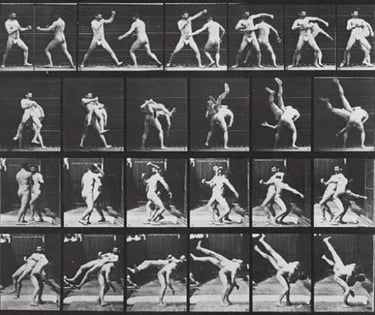
Fig. 13. Eadweard Muybridge, Wrestling, from Animal Locomotion, 1887.
Fig. 14. Thomas Eakins, Salutat, 1898.
Fig. 15. Isaac Cantrell, Mixed Martial Arts, Fight Night, 2017.
Fig. 16. Santiago Sierra, 160 cm Line Tattooed on 4 Paid People, 2000. Performance documentation.
Fig. 17. Marina Abramović, Rhythm 0, 1974. Performance documentation.
IV. THE RETURN OF PAN: Body Culture and the Illusion of Control
Pan never disappeared.
He was disciplined.
Contemporary body culture is built upon a promise of mastery. Strength can be developed, endurance can be measured, and physical appearance can be deliberately transformed. Through fitness regimes, wellness practices, and digital self-representation, the body increasingly becomes a project — something to be cultivated, evaluated, and improved. Michel Foucault’s analysis of modern power offers a way of understanding this transformation. Power operates not exclusively through prohibition or constraint, but through practices that organise bodily capacities and shape the conditions of human experience (Foucault, 1978). Read within contemporary body culture, this perspective reveals how collective expectations can gradually become indistinguishable from personal aspirations.
For the male body, this transformation carries particular significance. Strength, muscularity, and physical composure have long functioned as cultural markers of masculinity. Yet the contemporary male body is not simply expected to possess these qualities; it is increasingly invited to make them visible. Susan Bordo’s examination of male corporeality draws attention to the cultural expectations through which men’s bodies become objects of scrutiny, desire, and self-evaluation (Bordo, 1999). The body becomes both the subject of discipline and the evidence of its success.
The visual economy intensifies this relationship. Progress photographs, measurements, training records, and carefully composed images translate bodily experience into recognisable signs of achievement. What begins as a personal practice may acquire a public dimension, in which physical appearance becomes a means of communicating character. Bordo’s earlier examination of the relationship between cultural ideals and bodily regulation provides a useful framework for interpreting this development (Bordo, 1993). When self-control becomes associated with moral worth, the distinction between caring for the body and demonstrating mastery over it begins to narrow.
Yet the body remains an unreliable witness to the virtues attributed to it. Muscularity does not necessarily indicate confidence, physical composure does not guarantee psychological security, and an image of strength cannot disclose the complexity of the person who inhabits it. Injury, ageing, exhaustion, and anxiety interrupt the narrative of continuous improvement. These experiences need not invalidate the value of discipline, but they expose the limitations of a culture that interprets bodily uncertainty primarily through the language of personal achievement.
Art offers a means of confronting this contradiction. In Francis Bacon’s Three Studies for Self-Portrait (1979), the repeated image of the artist’s face refuses to settle into a coherent statement of identity (Metropolitan Museum of Art, n.d.). Across the three panels, recognition persists alongside distortion. The face remains identifiable, yet its apparent stability is repeatedly disturbed. Read through the concerns of this essay, Bacon’s painting suggests that identity does not depend upon the preservation of an intact image. The fractured representation becomes a means of approaching the complexity of embodied existence rather than concealing it.
A different disturbance of visual identity emerges in Cindy Sherman’s Untitled Film Stills (1977–1980). Through staged photographs that evoke familiar cinematic conventions, Sherman inhabits culturally recognisable female roles without presenting them as stable expressions of an authentic self (Museum of Modern Art, n.d.). Her work exposes the visual conventions through which gender becomes intelligible. Decades later, Amalia Ulman’s Excellences & Perfections (2014) extends a comparable challenge into the environment of social media. Through a carefully constructed online persona, Ulman demonstrates how familiar images of aspiration, beauty, and personal transformation can acquire the appearance of lived authenticity (Connor, 2014). Together, these works invite us to question how readily we mistake the coherence of an image for the coherence of a person.
This distinction becomes especially important when the body responds in ways that cannot be reconciled with its public presentation. Panic, fatigue, and physical uncertainty may disrupt the identity that an individual has learned to communicate. Brian Massumi’s theory of affect offers a conceptual reminder that bodily experience is not entirely exhausted by its conscious interpretation or visual expression (Massumi, 2002). There remains a dimension of corporeal life that cannot be fully translated into the language of achievement, failure, or improvement.
Here, Pan returns. His presence is not a rejection of discipline, physical beauty, or the desire to develop one’s capacities. Rather, he exposes the moment at which these aspirations become confused with the possibility of complete mastery. The contemporary body may be stronger, more carefully monitored, and more extensively represented, yet none of these conditions removes its vulnerability. The difficulty lies not in cultivating the body, but in accepting that cultivation can never make it entirely predictable.
The return of Pan is therefore an ethical disturbance. It asks whether we can recognise the value of a body without demanding that it demonstrate success, coherence, or control. It invites us to reconsider masculinity not as the uninterrupted performance of strength, but as an embodied condition in which strength and vulnerability remain inseparable. In this recognition, art regains one of its most important critical functions: not merely to reproduce the bodies we aspire to inhabit, but to make visible the experiences those aspirations may leave unacknowledged.
Perhaps the most difficult act of bodily acceptance is not learning to admire what we have become, but learning to recognise ourselves in what we cannot control.


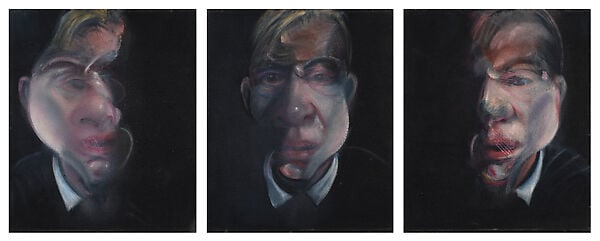

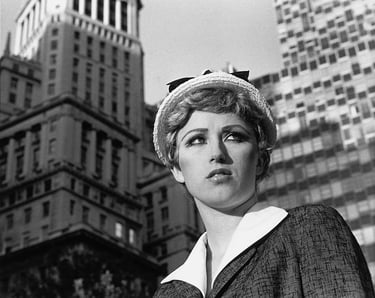

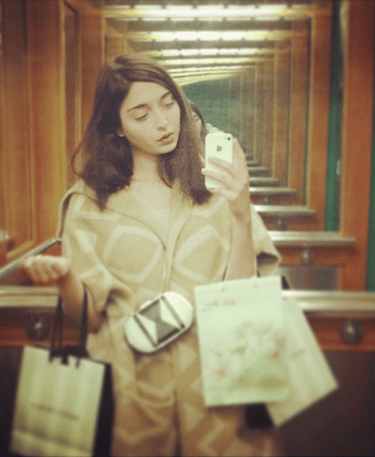


Fig. 18. Leni Riefenstahl, Olympia, 1938. Film still.
Fig. 19. Francis Bacon, Three Studies for Self-Portrait, 1979.
Fig. 20. Cindy Sherman, Untitled Film Still #21, 1978.
Fig. 21. Amalia Ulman, Excellences & Perfections, 2014. Digital performance documentation.
Fig. 22. Egon Schiele, Seated Male Nude (Self-Portrait), 1910.
In this early self-portrait, Schiele presents the male body as tense, exposed, and unsettled. Angular limbs, contorted posture, and anatomical fragmentation resist classical ideals of harmony and control. The body becomes a site of psychological intensity rather than aesthetic resolution. Read alongside Pan, Schiele’s work suggests that identity need not emerge through ideal form or physical mastery, but may instead become visible through vulnerability, discomfort, and the refusal of composure.
CONCLUSION
Pan does not demand belief.
He demands recognition.
This essay has not sought to rehabilitate an ancient god, nor to romanticise violence or physical endurance. Instead, it has traced a tension that persists across time: the fragile relationship between the body we inhabit and the meanings through which we understand it. From the ancient athletic arena to contemporary performance art and the carefully curated images of digital culture, the body emerges as something more complex than the forms through which it becomes visible.
In a culture saturated with images, vulnerability is not easily accommodated. The body is encouraged to perform, improve, and communicate achievement. For the male body in particular, the expectation of strength can become an expectation of emotional and physical invulnerability. Yet strength does not exempt the body from uncertainty. Nor does vulnerability diminish the significance of what discipline has enabled it to become.
Panic interrupts the apparent continuity between bodily experience and the narratives through which identity is sustained. It reminds us that the self is not an entirely autonomous construction, but something continually negotiated through sensation, memory, cultural expectations, and material existence. What becomes visible in moments of uncertainty is not a more authentic identity concealed beneath the surface, but the fragility of the conditions that allow identity to feel coherent.
Pan names this uncertainty. His relevance lies not in what he represents as an ancient deity, but in what his presence allows us to recognise about ourselves. Where identity is over-articulated, he introduces silence. Where form is fetishised, he exposes fragility. He reminds us that the boundaries between strength and vulnerability, intention and response, are never entirely secure.
Art occupies a distinctive position within this tension. Its value lies not only in its capacity to articulate beauty, but also in its ability to make uncertainty perceptible. A distorted face, an exhausted figure, or a body suspended between human and animal form can reveal dimensions of existence that an idealised image may leave unacknowledged. Beauty need not disappear when the body becomes vulnerable; it may acquire a different depth.
To acknowledge Pan is therefore not to abandon the pursuit of form, discipline, or self-understanding. It is to recognise their limits without interpreting those limits as failure. It is to allow the body to exist beyond the obligation to demonstrate mastery.
What remains, then, is not resolution, but attentiveness. Beneath every image lies a body capable of resistance. Beneath every narrative lies an experience that may exceed language. Beneath every form lies the possibility of change.
Perhaps the body was our first language precisely because it could express what words alone could never contain.
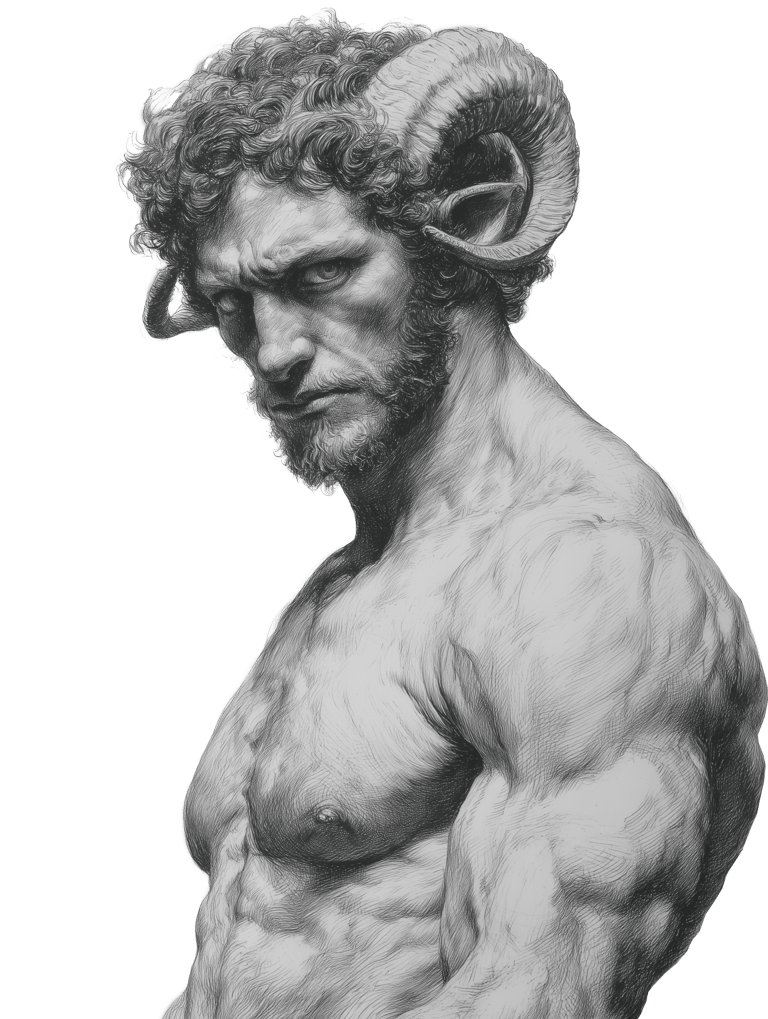
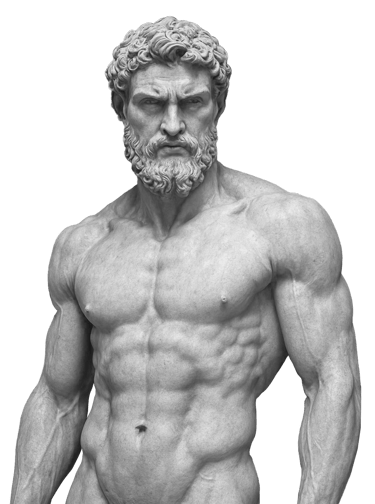
My interest in drawing Pan began not with mythology, but with anatomy. I wanted to explore how a body could retain the qualities of classical male beauty while simultaneously unsettling the expectations associated with it. Rather than returning Pan to the familiar imagery of pastoral mythology, I approached him as a figure caught between anatomical coherence and psychological uncertainty.
The horns are not intended as ornament or merely as an indication of mythological identity. They interrupt the familiarity of the human figure, introducing an element that resists immediate classification. I was interested in allowing the human and the animal to coexist without fully resolving the tension between them. What emerges is less a representation of a mythological character than an exploration of an embodied condition.
The musculature recalls the disciplined body of the classical athlete, yet the posture offers no declaration of triumph. The lowered head and searching gaze introduce a psychological tension that unsettles the apparent certainty of physical strength. I wanted the figure to possess a commanding physical presence without relying upon the conventional gestures through which masculine power is communicated. The challenge was to preserve the beauty of the male form without making that beauty dependent upon an appearance of invulnerability.
The drawing process itself became a way of exploring this contradiction. I approached the figure through anatomical observation, allowing its structure to develop gradually rather than imposing an expressive gesture from the outset. Lines were repeated, corrected, and occasionally left unresolved. These traces of hesitation became part of the visual language of the work. The discipline required to construct the figure existed alongside the decision not to resolve every aspect of it.
There is a paradox in using drawing — a practice concerned with observation, proportion, and the organisation of form — to explore the limits of control. I found this contradiction particularly meaningful. The same process through which the body becomes visually intelligible can also reveal the inadequacy of any single image to contain its complexity.
Placed alongside The Body Where Identity Breaks, the illustration is intended to exist in dialogue with the text rather than as its visual explanation. The written essay approaches the body through history, philosophy, and cultural criticism; the drawing approaches it through line, structure, and the material language of representation. Neither offers a complete account of the figure. Each leaves something for the other to question.
Ultimately, I did not want to draw Pan as a body undergoing transformation, but as a body suspended between possibilities — between what is recognisable and what remains unfamiliar, between the discipline of form and the uncertainty of existence.
I wanted to create a figure that could be admired without being entirely understood.
Artist’s Note


Pan (Πάν), 2026. Digital illustration by Sezer Ali. © Sezer Ali, 2026.
REFERENCES
Bordo, S. (1993) Unbearable Weight: Feminism, Western Culture, and the Body. Berkeley: University of California Press.
Bordo, S. (1999) The Male Body: A New Look at Men in Public and in Private. New York: Farrar, Straus and Giroux.
Borgeaud, P. (1988) The Cult of Pan in Ancient Greece. Translated by K. Atlass and J.M. Redfield. Chicago: University of Chicago Press.
Connor, M. (2014) ‘First Look: Amalia Ulman—Excellences & Perfections’, Rhizome, 20 October. Available at: https://old.rhizome.org/editorial/2014/oct/20/first-look-amalia-ulmanexcellences-perfections/ (Accessed: 27 November 2026).
Dizdar, I. (2019) ‘Toward Art, Toward Torture: Drawing the Line in the Work of Santiago Sierra’, Lapis. Available at: https://wp.nyu.edu/lapis/ivana-dizdar-art-torture-santiago-sierra/ (Accessed: 27 November 2026).
Foucault, M. (1977) Discipline and Punish: The Birth of the Prison. Translated by A. Sheridan. London: Allen Lane.
Foucault, M. (1978) The History of Sexuality, Volume I: An Introduction. Translated by R. Hurley. New York: Pantheon Books.
Irish Museum of Modern Art (n.d.) Rhythm 0, 1974. Available at: https://imma.ie/collection/rhythm-0/ (Accessed: 27 November 2026).
Jones, A. (1998) Body Art/Performing the Subject. Minneapolis: University of Minnesota Press.
Kon, I.S. (2003) Мужское тело в истории культуры [The Male Body in Cultural History]. Moscow: Slovo.
Massumi, B. (2002) Parables for the Virtual: Movement, Affect, Sensation. Durham, NC: Duke University Press.
Metropolitan Museum of Art (n.d.) Francis Bacon: Three Studies for Self-Portrait. Available at: https://www.metmuseum.org/art/collection/search/489966 (Accessed: 27 November 2026).
Museum of Modern Art (n.d.) Cindy Sherman: Untitled Film Stills, 1977–80. Available at: https://www.moma.org/momaorg/shared/flattened_pages/moma_learning/cindy-sherman-untitled-film-stills-1977-80/ (Accessed: 27 November 2026).
Neer, R.T. (2010) The Emergence of the Classical Style in Greek Sculpture. Chicago: University of Chicago Press.
Plato (2005) Phaedrus. Translated by C. Rowe. London: Penguin Classics.
Poliakoff, M.B. (1987) Combat Sports in the Ancient World: Competition, Violence, and Culture. New Haven: Yale University Press.
Turner, V. (1969) The Ritual Process: Structure and Anti-Structure. Chicago: Aldine Publishing Company.
Vernant, J.-P. (1983) Myth and Thought among the Greeks. London: Routledge & Kegan Paul.
IMAGE CREDITS
Fig. 1. Boxer at Rest (also known as the Terme Boxer), late 4th–2nd century BCE. Hellenistic Greek bronze inlaid with copper. Museo Nazionale Romano, Palazzo Massimo alle Terme, Rome, Italy. Inv. 1055.
Fig. 2. Euphronios (painter) and Euxitheos (potter), Sarpedon Krater, c. 515 BCE. Attic red-figure terracotta calyx-krater. Museo Nazionale Archeologico Cerite, Cerveteri, Italy.
Fig. 3. Wrestlers (also known as the Uffizi Wrestlers), 1st century CE. Roman sculpture in Parian marble, 89 cm in height. Gallerie degli Uffizi, Florence, Italy. Inv. 1914 n. 216.
Fig. 4. Eadweard Muybridge, Running, from Animal Locomotion, 1887. Photographic motion study, collotype.
Fig. 5. Francis Bacon, Two Figures, 1953. Oil on canvas, 152.5 × 116.5 cm. Private collection. Catalogue raisonné no. 53-24.
Fig. 6. Michelangelo Buonarroti, Male Nude, Seen from the Rear (verso), study for the Battle of Cascina, c. 1504. Black chalk, heightened with white. ALBERTINA, Vienna, Austria. Inv. 123v.
Fig. 7. Hendrick van Balen the Elder and follower of Jan Brueghel the Elder, Pan pursuing Syrinx, possibly after 1615. Oil on copper, 25 × 19.4 cm. The National Gallery, London, United Kingdom. Inv. NG659. Bought, 1860.
Fig. 8. Titian (Tiziano Vecellio), Bacchus and Ariadne, 1520–1523. Oil on canvas, 176.5 × 191 cm. The National Gallery, London, United Kingdom. Inv. NG35. Bought, 1826.
Fig. 9. Henry Fuseli, The Nightmare, 1781. Oil on canvas, approximately 101.6 × 126.7 cm. Detroit Institute of Arts, Detroit, Michigan, United States.
Fig. 10. Egon Schiele, Nude Self-portrait, Squatting, 1916. Graphite and gouache on brown packing paper, 29.5 × 45.8 cm. ALBERTINA, Vienna, Austria. Inv. 31262.
Fig. 11. Francis Bacon, Study after Velázquez’s Portrait of Pope Innocent X, 1953. Oil on canvas, 153 × 118 cm. Des Moines Art Center, Des Moines, Iowa, United States. Nathan Emory Coffin Collection, purchased with funds from the Coffin Fine Arts Trust. Inv. 1980.1. Catalogue raisonné no. 53-02.
Fig. 12. Foundry Painter (attributed), Attic red-figure kylix depicting pankration, c. 490–480 BCE. Terracotta. Excavated at Vulci, Italy. British Museum, London, United Kingdom. Registration no. 1850,0302.2 (E78).
Fig. 13. Eadweard Muybridge, Wrestling, from Animal Locomotion, 1887. Photographic motion study, collotype.
Fig. 14. Thomas Eakins, Salutat, 1898. Oil on canvas, 126.4 × 101 cm. Addison Gallery of American Art, Phillips Academy, Andover, Massachusetts, United States. Accession no. 1930.18.
Fig. 15. Isaac Cantrell, Mixed martial artists battle it out during Fight Night 2017, 13 October 2017. Digital photograph. Marine Corps Air Ground Combat Center, Twentynine Palms, California, United States. U.S. Marine Corps photograph, via Defense Visual Information Distribution Service (DVIDS). Photo ID: 3879276. Public Domain.
Fig. 16. Santiago Sierra, 160 cm Line Tattooed on 4 People, December 2000. Performance and photographic documentation. El Gallo Arte Contemporáneo, Salamanca, Spain.
Fig. 17. Marina Abramović, Rhythm 0, 1974. Six-hour performance at Studio Morra, Naples, Italy. Photographic documentation.
Fig. 18. Leni Riefenstahl (director), Olympia, 1938. Black-and-white documentary film depicting the 1936 Berlin Olympic Games, produced within the ideological context of Nazi Germany. Film still.
Fig. 19. Francis Bacon, Three Studies for Self-Portrait, 1979. Oil on canvas, triptych, each panel 37.5 × 31.8 cm. Metropolitan Museum of Art, New York, United States. Jacques and Natasha Gelman Collection, 1998. Accession no. 1999.363.1a–c.
Fig. 20. Cindy Sherman, Untitled Film Still #21, 1978. Gelatin silver print, 19.1 × 24.1 cm. Museum of Modern Art (MoMA), New York, United States. Horace W. Goldsmith Fund through Robert B. Menschel. Object no. 830.1995.
Fig. 21. Amalia Ulman, Excellences & Perfections, 2014. Internet-based performance and photographic documentation disseminated through Instagram and Facebook.
Fig. 22. Egon Schiele, Seated Male Nude (Self-Portrait), 1910. Oil and opaque colour on canvas, 152.5 × 150 cm. Leopold Museum, Vienna, Austria. Inv. 465.
Cover Illustration: Sezer Ali, Pan (Πάν), 2026. Original digital illustration created for The Notebook. © Sezer Ali, 2026. All rights reserved.

>> HISTORICAL REPRESENTATION >> SHIFTING PERSPECTIVES AND CHALLENGES >> CONTEMPORARY EXPLORATIONS