
DESIRE
by Sezer Ali | APR 15, 2026 | SOCIETY & CULTURE
Forbidden
WHAT HISTORY TELLS US ABOUT WHO WE ARE
A QUESTION THAT REFUSES TO GO AWAY
There is a particular kind of vertigo that comes from reading history — the sudden sense that the ground beneath your feet is not as solid as you thought. That what you assumed to be natural is, in fact, constructed. That who you believe yourself to be is, in some measure, a product of when and where you were born.
Noel Malcolm's Forbidden Desire: Male-Male Sexual Relations in Early Modern Europe, 1400–1750 provoked exactly that feeling in me. It is a vast, meticulous, and often uncomfortable book — one that refuses easy consolation while offering something more valuable in its place: clarity.
The book's central argument is deceptively simple. Between 1400 and 1750, sex between men followed distinct patterns in different places. In Mediterranean cultures — both Christian and Islamic — a form of pederastic sodomy was widespread, typically involving an adult man and a beardless youth. In Northern Europe, no such pattern is discernible. The prosecutions are sparser, the age dynamics absent, the records largely silent. Two cultures, two entirely different stories.
This is not merely a historical curiosity. It is an invitation to ask a harder question: what does it mean to have a sexuality at all when the very categories we use to describe it are so clearly shaped by time, geography, and power?
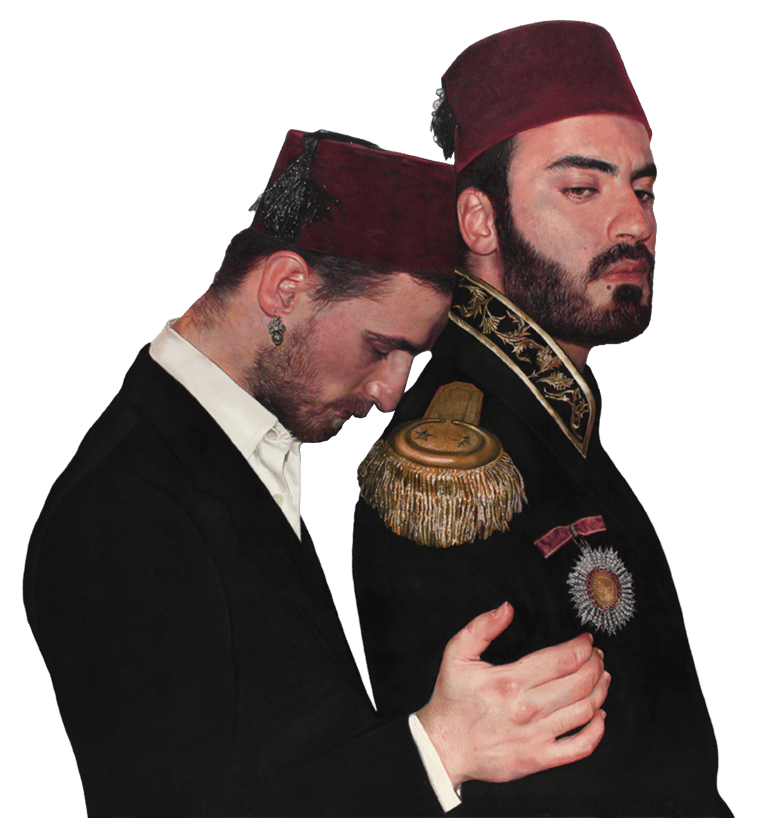
1923 by Taner Ceylan, 2010 (From the lost painting series)
© Taner Ceylan, courtesy of Paul Kasmin
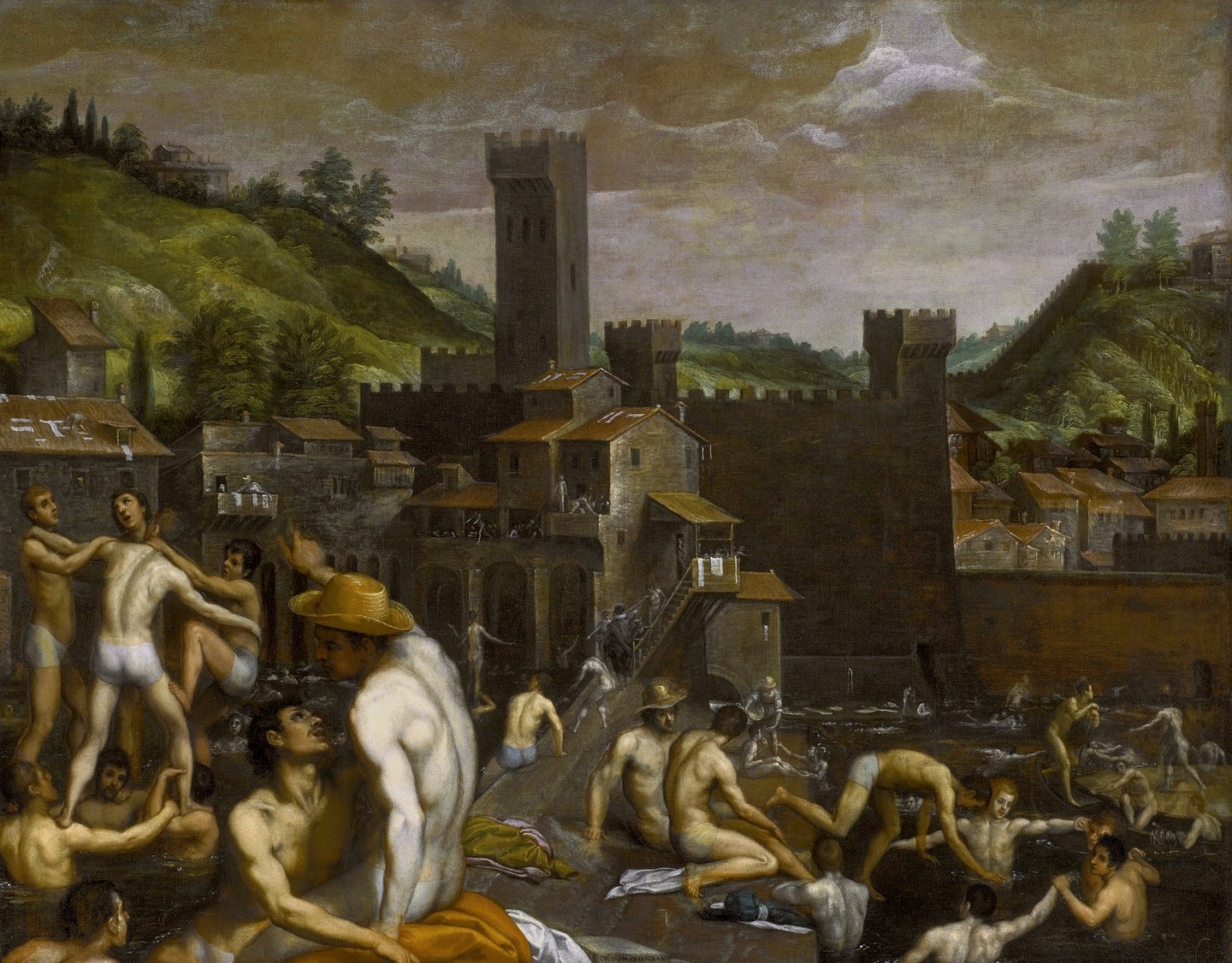
Domenico Cresti, called Passignano, Bathers at San Niccolò, 1600, oil on canvas, Private Collection.
THE MEDITERRANEAN PATTERN
Malcolm's most striking material comes from Florence, where the Office of the Night – an anti-sodomy magistracy – operated between 1432 and 1502. Over seventy years, it investigated as many as sixteen thousand men in a city whose total population hovered between forty and fifty thousand. Among those investigated: Leonardo da Vinci.
The numbers are extraordinary. But what they reveal is not a culture of shame so much as a culture of ambivalence. The typical case followed a recognisable pattern: the active partner was a young adult man, the passive partner a teenager. Age determined role, and role determined culpability. Bottoms, as the historical record confirms with grim consistency, always received harsher treatment.
Germany developed a telling euphemism for sodomy: “florenzen” — "to Florence”. The Florentines, for their part, were not always troubled by the reputation. After Savonarola's downfall, one city official was reported to have said: "Thank God, now we can sodomise."
This is history at its most disorienting — not because it shocks, but because it refuses to fit the narratives we've built. Was this proto-gay culture? A Mediterranean sexual economy entirely unlike our own? Malcolm resists the temptation to flatten the evidence into a satisfying modern story.
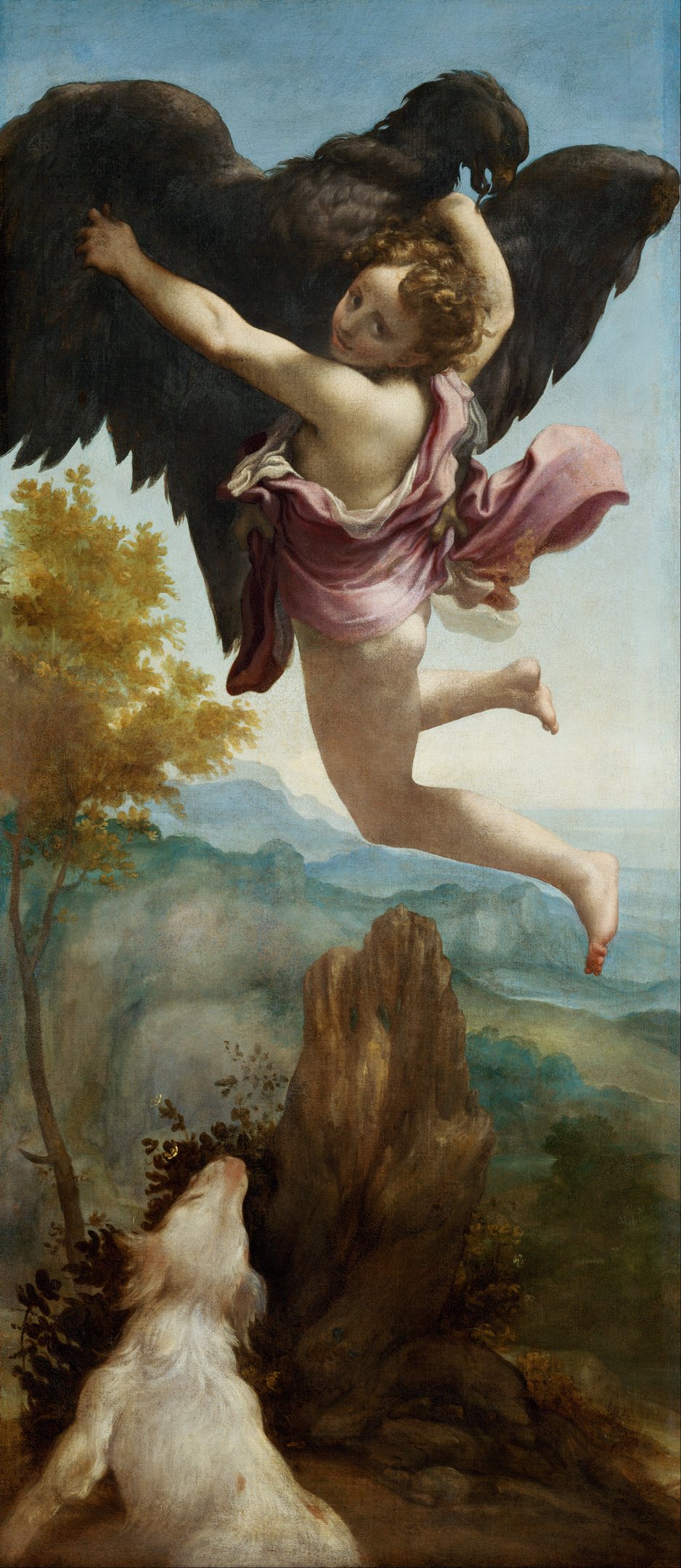
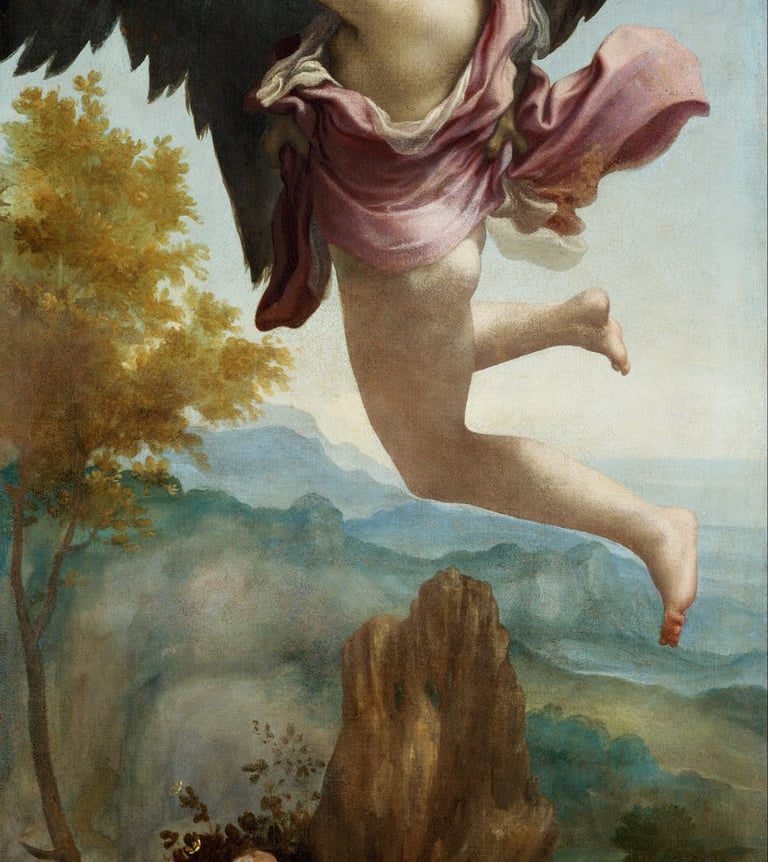
Jupiter and Ganymede by Antonio Allegri Correggio (c. 1532)
ISTANBUL: WHERE THE ARCHIVE BEGINS
The kernel of Forbidden Desire is a discovery Malcolm made while researching Ottoman diplomatic history — an investigation conducted in 1588 by the Venetian high representative in Istanbul into two young members of his household.
Gianesino was the son of a local Christian family. Gregorio was a barber, recently arrived from Venice. By the time of the inquiry, Gianesino had been expelled from the household, and contact between the two was prohibited. What follows across sixteen manuscript pages is something rare in the historical archive: not a trial record, but an internal inquiry interested in motivation and feeling as much as in acts.
Witnesses describe seeing the two young men kissing at the window of Gianesino's room. Gazing at each other across the dinner table. Everyone in the house, the testimony confirms, believed them to be in love. Gianesino had given Gregorio gifts: silks, satin gloves, a cap, and a knife. Gregorio had crept out at night even after the prohibition and insisted he would see Gianesino "even if the gallows were prepared for him”.
When questioned, Gregorio agreed with the kitchen boy's verdict. "I shall tell you the truth," he said. "I loved him greatly, I took pleasure in his company, and I slept with him several times."
Gregorio was eventually deported to Crete, where he vanishes from the record. But the texture of this story — the silks, the stolen looks, the declaration made in front of a powerful official — lingers. Countless Gregorios and Gianesinos, Malcolm writes, and their sincere loves are lost to us.
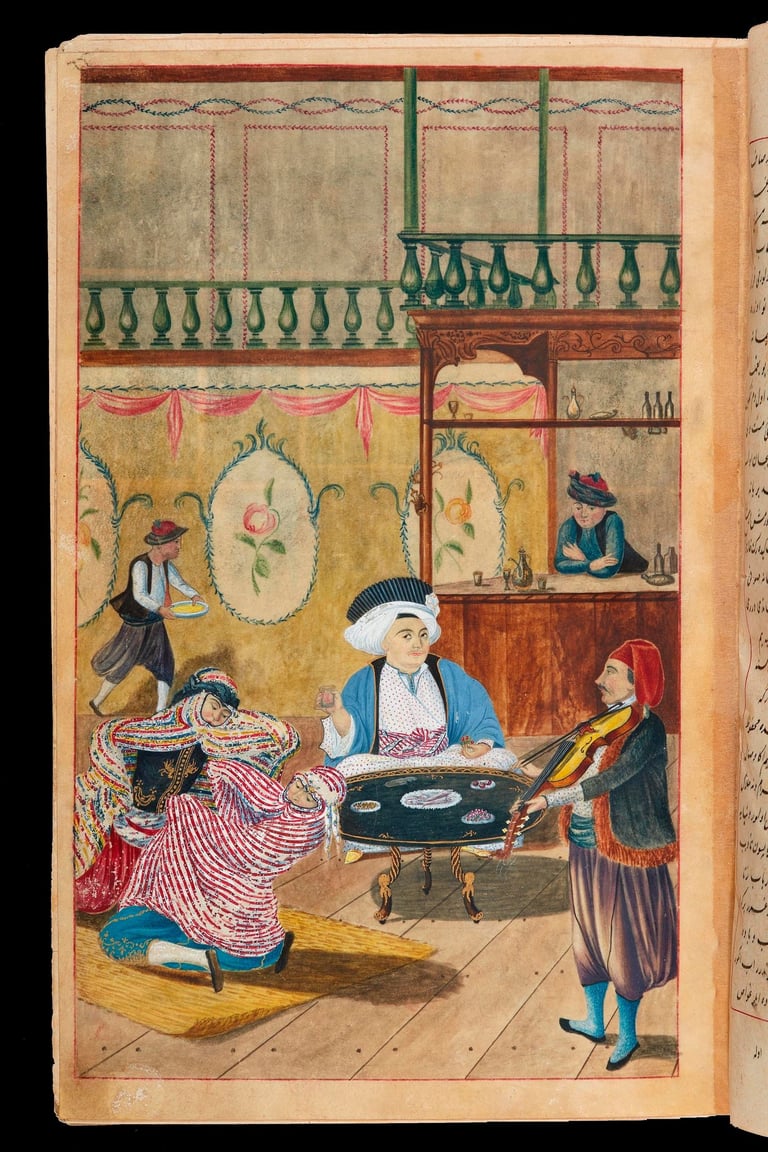
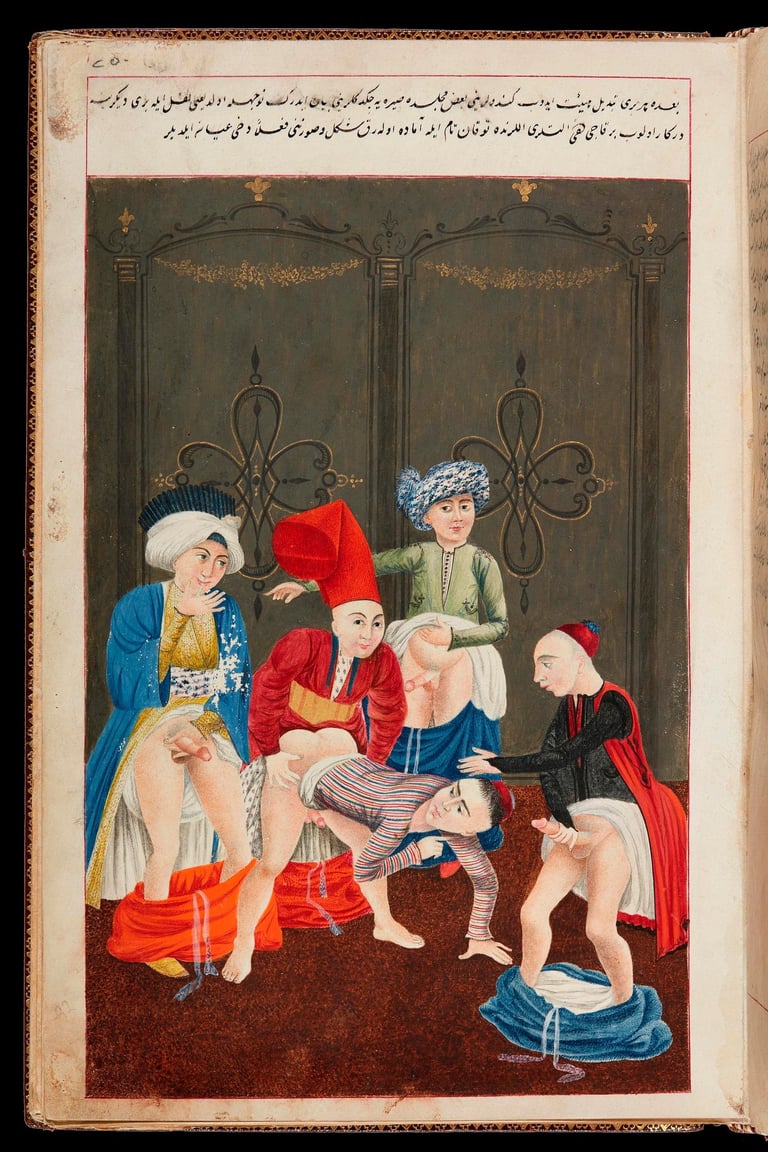
Manuscript. Illustrated compendium of erotic texts, 209 leaves. Ottoman Empire, between 1799 and 1817. The David Collection, Copenhagen. Photo: Pernille Klemp.
THE OTTOMAN WORLD
Malcolm's rehabilitation of Ottoman sexual history is among the book's most significant contributions. Scholars have long been suspicious of European accounts of sodomy in the Ottoman world, tending to dismiss them as orientalist projection — a way, as Edward Said put it, of controlling the "redoubtable Orient”.
Malcolm is having none of it. He demonstrates, carefully and conclusively, that sex between men was widely existing and widely known to exist in the Ottoman world. A sixteenth-century fatwa permitted an imam to ban an attractive boy from standing at the front during prayers, lest he distract men from their devotions. An eighteenth-century poet celebrated the dancing boys of the taverns. One Turkish literary genre laments the appearance of down on a boy's cheeks – what the internet has since, with characteristic brevity, termed "twink death”.
The Ottoman world was not, Malcolm is careful to note, a paradise. The ma'būn — an adult man who sought pleasure from being penetrated — was regarded with contempt and considered to suffer from a dangerous pathology. The power dynamics were often brutal. But theoretical disapproval was modulated by open cultural celebration and a legal regime that made actual conviction difficult, producing a culture of open but discreet sodomy very different from Western Christendom's atmosphere of paranoia and shame.
That shame, Malcolm suggests, has left its mark on us. The Western habit of hiding and revealing, of confession and concealment, of coming out — these are not universal human experiences. They are the particular inheritance of a culture that made sexuality into a secret.
ADVERTISEMENT
WHAT THE ARCHIVE CANNOT HOLD
There are love letters in these pages that are difficult to read without feeling something.
A Portuguese sacristan sent plaintive letters to a guitarist, recalling physical intimacy with a tenderness that time has not erased. The letters survive because the guitarist passed them to the Inquisition — confirming, as James Butler acidly notes in his review of the book, certain modern dating advice about musicians.
A monk, writing to "my little bewitcher, my puppy”, in what the archive confirms was a reciprocated affair, wrote in his lover's absence: "You have already begun to kill me. I die, my dear! Help me; I die with longing for you."
These are not the words of a category. They are not the words of a sodomite, a homosexual, a queer person, or any other taxonomy the centuries have produced. They are the words of someone in love, writing across the distance that separated them from the person they could not reach.
The historical study of homosexuality has always had a particular political urgency. To have a history is to be real. To possess a past is to claim political legitimacy. Gay identity, as one scholar puts it, is often not formed in childhood within the family but sought out later — sometimes secretly, sometimes transgressing familial expectations. The discovery of people like oneself in history can act, for those who grew up paralysed by shame, as a catalyst for self-acceptance.
Malcolm is a distinguished intellectual historian and an outsider to the history of sexuality, which gives him both advantages and limitations. He is brilliant at puncturing dogma, at exposing wishful readings, at resisting the temptation to project modern identities onto historical actors. He is less comfortable with the emotional stakes of the archive. The monk's letter is evidence. It is also a human being.
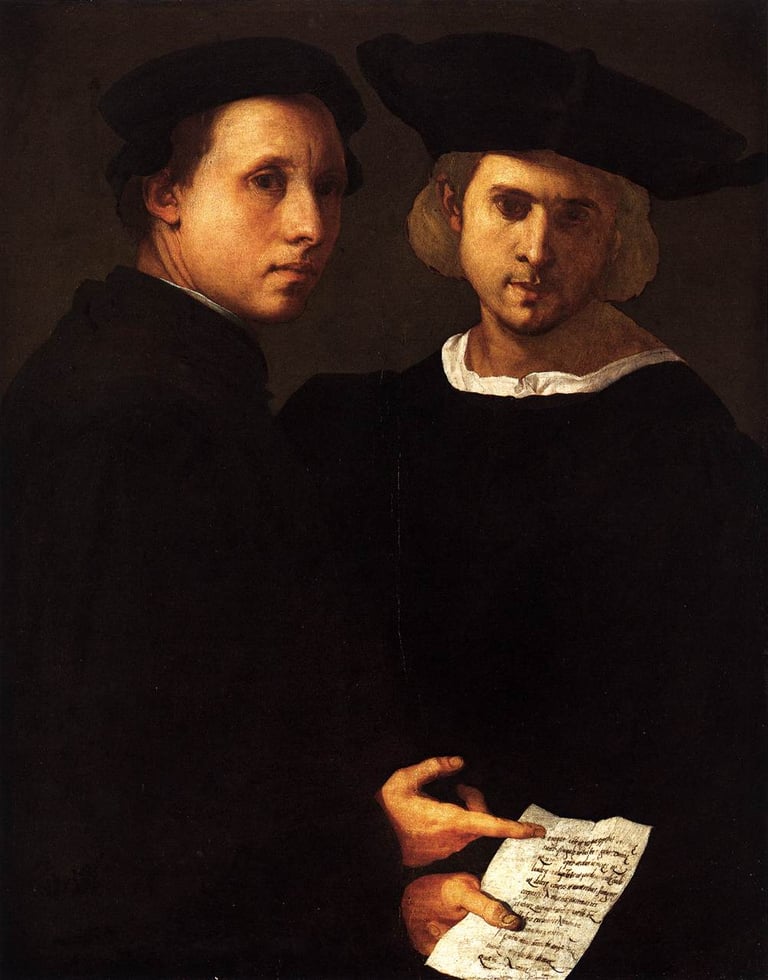
Portrait of Two Men by Jacopo Pontormo (c. 1524)
FOUCAULT'S QUESTION
The philosopher Michel Foucault made the distinction that has haunted this field ever since: the sodomite was someone who committed a sin; the homosexual is now a species. Before a certain moment in history, sexuality was classified only as a series of prohibited or permitted acts. After that moment, it became an inner identity — something one was, not merely something one did.
One of the unexpected achievements of Forbidden Desire is its demonstration that this transition was neither as clean nor as late as Foucault suggested. Speculation about coherent sexual inclination — about ce métier, about being "of that type" — is commonplace in the sources Malcolm examines. A Venetian priest in 1628 reasoned that if God created the anus capable of giving pleasure, it could not possibly be sinful to use it for that purpose. A Dutch preacher attributed his desires to a biological inheritance from his mother. A French chevalier caught cruising in 1720s Paris attacked the arresting policemen with his sword and threatened to have the senior officer dismissed, adding that he intended to do as he pleased in the Tuileries garden without anyone daring to stop him.
These are not simply people who performed prohibited acts. They are people who, in various ways, understood themselves in relation to those acts — who had, in some nascent sense, an identity.
Malcolm concludes, somewhat to the reader's surprise, as a "moderate constructionist" — someone who believes that modern sexuality is significantly different from its antecedents even while acknowledging the continuities. This is probably the honest position. Our own socio-sexual architecture — with its taxonomy of identities, its negotiated monogamies, and its experiments in openness — may well strike future generations as equally strange.
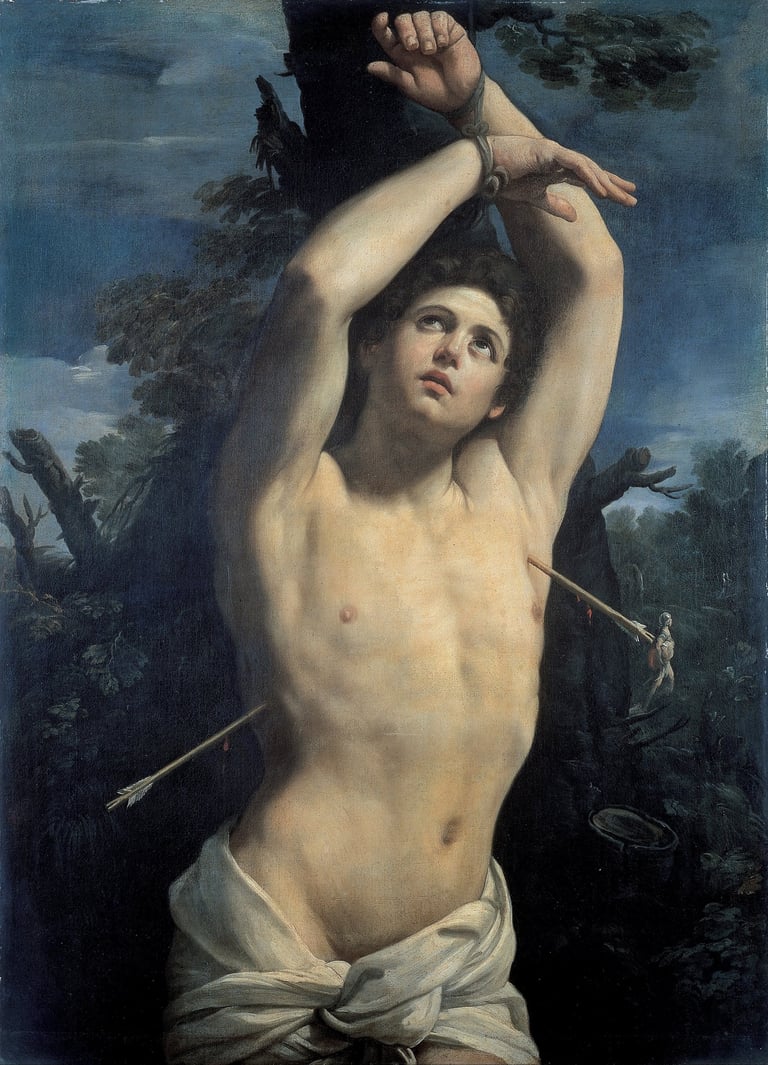
Saint Sebastian by Guido Reni (1615)
THE LIMITS OF HISTORY
History breeds discomfort. The prehistory of homosexuality cannot, as Malcolm makes clear, be easily disentangled from the history of pederasty. Many of the relationships the archive preserves involved significant age differentials and power imbalances that we would today classify as abuse. These facts do not become less uncomfortable by acknowledging that historical views of maturity were not our own.
Malcolm is not detained by what historians call presentism — the tendency to judge the past by the standards of the present. But it is harder for a reader to avoid. The two seventeen-year-old boys were burnt at the stake in Seville in 1579 for "immoral touchings”. The Sienese law that decreed hanging from the genitals. The Venetian cleric was placed in a cage in the Piazza San Marco in 1407 so that he could starve to death for public edification, the agents of the law thus avoiding the moral turpitude of killing an ordained man more directly.
Rage, reading this, is unavoidable. And perhaps appropriate.
ADVERTISEMENT
WHAT LINGERS
I keep returning to Gregorio and Gianesino. Not to the outcome — the deportation, the erasure, the silence — but to the moment before. The silks. The satin gloves. The insistence on seeing someone "even if the gallows were prepared”.
Malcolm's book is ultimately a monument to the limits of categories. The word "homosexual" was coined in 1869; the word "heterosexual" followed shortly afterwards. Before these words existed, people loved each other in ways that do not map neatly onto the taxonomies we have inherited. The Florentine weaver "who sees no other god" but his boy. The doctor who commits the greatest follies in the world for himself. The monk who dies with longing.
Alan Bray, one of the pioneers of this field, wrote that readers can and will — and must — appropriate the past for themselves. Malcolm is more cautious, and his caution is intellectually respectable. But as a reader — and as someone for whom this history carries a particular weight — I find myself closer to Bray.
The sexual fact and the possibility of human love and devotion remained constant over time, whatever the vocabulary. These sodomites were human beings. Their loves were real. The archive holds them imperfectly, and we are permitted to claim them — not as mirror images of ourselves, but as evidence that the desire to love and to be known by someone does not require a category in order to exist.
Forbidden Desire: Male-Male Sexual Relations in Early Modern Europe, 1400–1750 by Noel Malcolm is a monumental work of historical scholarship, spanning three and a half centuries and multiple cultures across Europe and the Mediterranean world. Drawing on an extraordinary range of archival sources — from Venetian court records and Ottoman manuscripts to Inquisition files and legal codes — Malcolm constructs a meticulous and often surprising account of how sex between men was understood, practised, and punished across radically different societies. At once a work of rigorous comparative history and a profound meditation on the limits of the categories we use to understand ourselves, Forbidden Desire is essential reading for anyone interested in the history of sexuality, identity, and the human capacity for love in the face of prohibition.
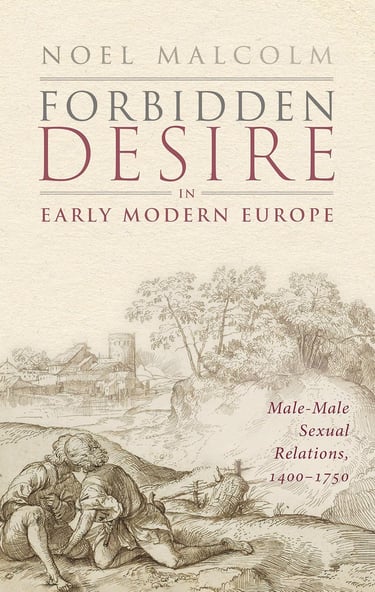
FORBIDDEN DESIRE BY NOEL MALCOLM
References
Malcolm, N. (2025). Forbidden Desire: Male-Male Sexual Relations in Early Modern Europe, 1400–1750. Oxford University Press.
Butler, J. (2026). 'Am I Perhaps in Italy?', London Review of Books, Vol. 48, No. 6, 2 April.
Rocke, M. (1996). Forbidden Friendships: Homosexuality and Male Culture in Renaissance Florence. Oxford University Press.
Foucault, M. (1978). The History of Sexuality, Volume 1: An Introduction. Pantheon Books.
Bray, A. (2003). The Friend. University of Chicago Press.
Crompton, L. (2003). Homosexuality and Civilisation. Harvard University Press.
Image References
Ceylan, T. (2010) 1923 (From the Lost Paintings Series). Oil on canvas. © Taner Ceylan, courtesy of Paul Kasmin Gallery, New York.
Cresti, D. (called Passignano) (1600). Bathers at San Niccolò. Oil on canvas, 142.2 × 180.3 cm. Private Collection.
Allegri, A. (called Correggio) (c. 1532). Jupiter and Ganymede. Oil on canvas. Kunsthistorisches Museum, Vienna.
Anon. (c.1799–1817) Manuscript: Illustrated Compendium of Erotic Texts, 209 leaves. Ottoman Empire. The David Collection, Copenhagen (Inv. 8/2018). Photo: Pernille Klemp.
Pontormo, J. (c. 1524). Portrait of Two Men. Oil on canvas. Museo Nazionale di Palazzo Venezia, Rome.
Reni, G. (1615) Saint Sebastian. Oil on canvas. Pinacoteca Nazionale, Bologna.