
I watched the finale of Half Man last night, and I'm still not sure what to do with what it left behind. Not confusion — I understood what happened. But there's something sitting in my chest after that last episode. Something that resists being named.
Richard Gadd does something uncomfortable — and he does it well. First Baby Reindeer, now Half Man. Twice he's stepped into the skin of a man, dug around in there, and pulled out things most of us would rather leave undisturbed. Ruben and Niall aren't simply two Scottish men with damaged childhoods. They're two faces of the same thing – that tension living inside men that never quite finds a healthy way out.
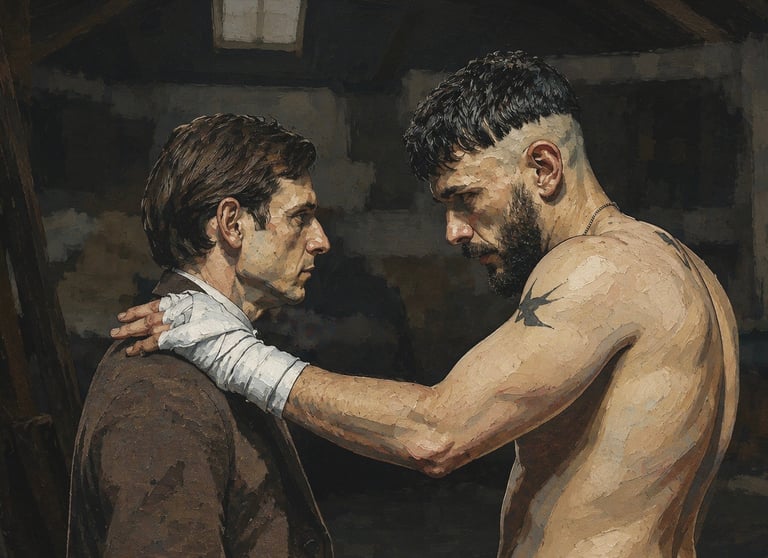
Ruben is the body. Niall is the mind. One acts before he thinks; the other thinks so much he never acts. Both are half a man — differently, but equally incomplete.
The question I woke up with the next morning was simple but uncomfortable: who are we proving it to?
Masculinity isn't something you're born ready for. It's a role – one handed to you before you ever asked for it. Your father hands it to you. School hands it to you. The street hands it to you. So do the men whose approval you learn to crave. Ruben is an abuser, yes — but he's also a product. Every act of aggression, every bid for dominance, every 'I'm stronger than you' is an attempt to fill something that was taken from him before he even knew he had it.
"It makes you a half-man," Ruben says of the abuse his father inflicted on him. And then he spends his entire life trying to fill that half with things that have nothing to do with it — domination, control, the fear he puts in others. As a man, if you're honest with yourself, you understand that logic. You don't excuse it, but you understand it. Because at some point, we've all run that same calculation: Am I enough? Strong enough, brave enough, man enough?
What nobody tells you is that calculation never balances.
HALF MAN
What Half Man Reveals About Masculinity
by Sezer Ali | JUN 1, 2026
Niall is the other side of this. Quieter, more reflective – a good brother by every measure. But he's been hiding something for years: his sexuality. And it's that concealment, more than anything else, that slowly hollows him out. Not the sexuality itself — the fear of it. The fear of what people will say. The fear of Ruben, the one person he could never find the courage to tell.
Here, Half Man reaches beyond the queer experience into something more universal — the male fear of vulnerability. How much do we hide to protect the image? How many versions of ourselves do we construct to meet other people's expectations? Sexual identity is just one layer. Underneath it, there's so much more.
We live in a moment where masculinity is being questioned from every direction. The manosphere offers a simple answer: be harder, dominate, never apologise. Feminism challenges the entire construction. And men – many of them – stand somewhere in the middle, disoriented, without the language to talk about themselves.
Half Man doesn't offer an easy answer. It doesn't offer any answer at all. Instead, it does something more honest — it shows you the cost. Ruben and Niall die at each other's hands. Not metaphorically. Literally. And in that final barn scene there is something almost ritualistic — two men, incapable of loving each other openly and equally incapable of letting go.
Is the ending too dramatic? Perhaps. But the point stands: toxic masculinity isn't a stylistic choice – it's erosion, not explosion.
I won't claim to know what masculinity is. I don't have an answer to the question Gadd leaves us with. But after the finale of Half Man, I'm more certain than ever that the problem isn't strength — it's the fear of weakness. The more unshakeable we appear, the more fragile we are. And the longer we refuse to admit it, the higher the price.
Maybe real masculinity — if such a thing even exists — is learning to live with the half of yourself that doesn't fit the role. Not to kill it. Not to hide it. Just to let it exist.
Gadd shows us what happens when we don't.
Masculinity isn't something you're born ready for. It's a role — and one handed to you before you ever asked for it.
Two men. One role. Neither of them asked for it.
Half Man
What Half Man Reveals About Masculinity