
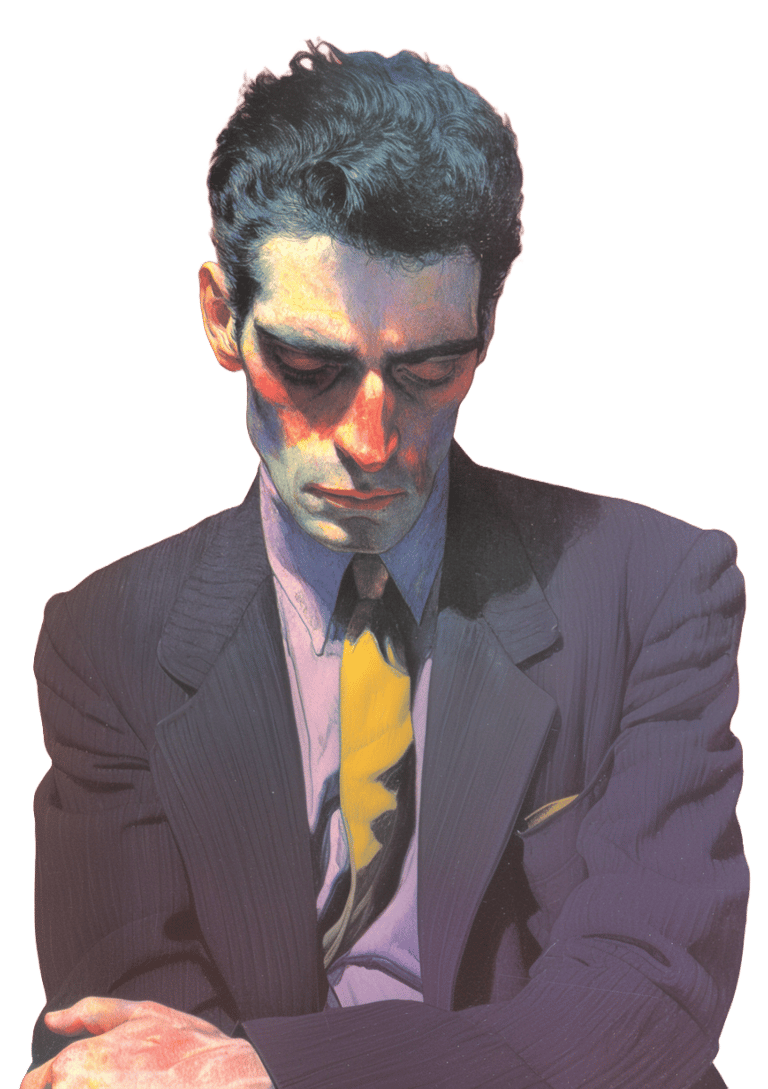
In recent years, the question is no longer whether toxic personalities exist within corporate environments, but why they so often rise to the top. The image of the confident leader—rational, charismatic, strategically flawless—increasingly conceals not vision, but deficit: a lack of empathy, an instrumental view of others, and a cold willingness to cause harm, so long as that harm remains institutionally invisible.
As Paul Babiak and Robert D. Hare observe, corporate psychopaths rarely appear threatening. On the contrary, they are often perceived as exemplary professionals: confident, adaptable, and persuasive. The problem is not that they break the rules, but that they weaponise them (Babiak and Hare, 2006).
Or, as Hannah Arendt famously noted in a different but unsettlingly relevant context:
“The greatest evil in the world is not committed by monsters but by ordinary people who refuse to think.”
– Arendt, 1963
Here, harm is not spectacular. It is rational, procedural, and frequently rewarded.
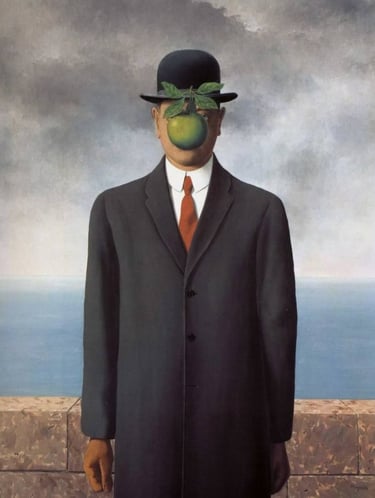
René Magritte, The Son of Man (1964)
Magritte’s The Son of Man operates as a visual prelude to the article’s central concern: the tension between visibility and accountability within modern institutions. The anonymous businessman—immaculately dressed, upright, and socially legible—embodies the ideal of professional respectability. Yet his face, the site of recognition, intention, and moral response, is deliberately obstructed.
The floating apple does not erase the subject but interrupts access to him, staging what Magritte once described as the paradox of “the visible that hides the visible.” In this sense, the painting anticipates contemporary discussions of social mimicry and institutional approval: the outward performance of normality remains intact, even exemplary, while ethical interiority is rendered inaccessible. What confronts the viewer is not deviance, but concealment—an image of conformity so complete that it resists scrutiny.
FROM THE DARK TRIAD TO A DARK ARCHITECTURE OF PERSONALITY
For decades, the concept of the Dark Triad — psychopathy, narcissism, and Machiavellianism — has dominated psychological attempts to explain socially aversive personalities. Paulhus and Williams define the triad as a cluster of traits united by interpersonal callousness and self-centredness (Paulhus and Williams, 2002).
Yet empirical reality increasingly undermines this neat separation. In organisational and power-laden contexts, these traits rarely manifest independently. Instead, they function as a unified behavioural strategy, flexibly deployed according to circumstance. Narcissistic grandiosity attracts, Machiavellian calculation plans, and psychopathic coldness executes.
This raises a deeper philosophical problem: have we fragmented a single moral deficit into measurable components simply to make it scientifically manageable? As Michel Foucault reminds us, classification does not merely describe reality—it actively produces it (Foucault, 1980).
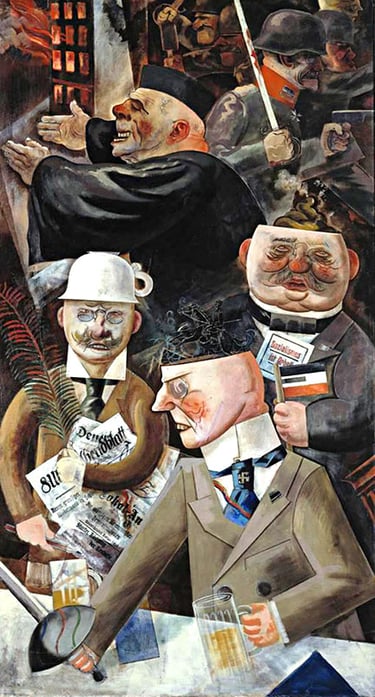
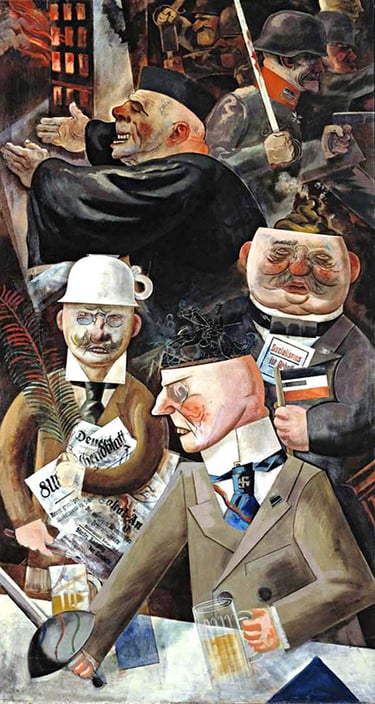
George Grosz, The Pillars of Society (1926)
Grosz’s The Pillars of Society violently dismantles the illusion of moral authority that underpins political and corporate power. Figures meant to embody stability, leadership, and civic virtue are rendered grotesque, bloated, and internally hollow—literally open-headed, their thoughts occupied not by reason or responsibility, but by ideology, militarism, and self-interest. Respectability here is not a marker of integrity but a camouflage for decay.
Within the context of this article, Grosz’s painting marks a shift from concealment to exposure. Unlike Magritte’s quiet obstruction, The Pillars of Society insists on revelation: the institutional elite are shown not as anomalies but as structural failures, sustained by mutual reinforcement rather than ethical coherence. Grosz anticipates a central argument of contemporary dark personality research—that harmful leadership is rarely the product of isolated pathology, but of systems that reward conformity, obedience, and ruthless efficiency while normalising moral vacancy.
THE UNIFIED "DARK" SUBJECT: BEYOND CATEGORIES
It is precisely at this point that the work of Karen Lee Mitchell becomes crucial. In her 2024 research, Mitchell challenges the logic of separating psychopaths, narcissists, Machiavellians, toxic leaders, and coercive controllers into discrete types. Instead, she proposes that these figures represent subsets of one overarching dark personality structure (Mitchell, 2024).
This structure is not defined by a checklist of traits but by a stable behavioural logic:
an instrumental relationship to others,
an absence of moral reciprocity,
social mimicry,
and a readiness to cause harm when it serves power or control.
Here, the dark personality is no longer a defect but an adaptation. As Kevin Dutton argues, certain psychopathic characteristics can become functional assets in competitive, hierarchical environments where hesitation and empathy are interpreted as weakness (Dutton, 2012).
“Psychopathy is not necessarily a disorder. In some contexts, it is a strategy.”
– Dutton, 2012
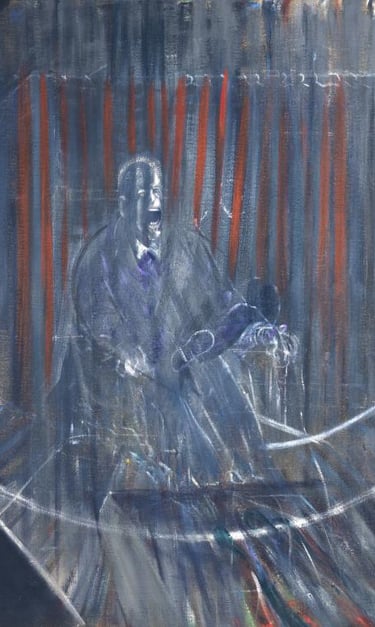
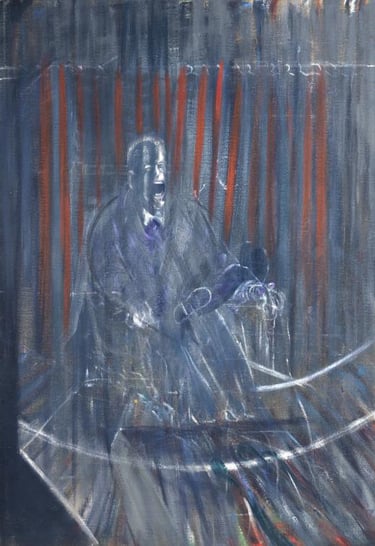
Francis Bacon, Figures in Isolation (various)
Francis Bacon’s isolated figures inhabit a psychological space where the self remains intact yet profoundly destabilised. Suspended within transparent cages, anonymous rooms, or indeterminate interiors, these bodies appear neither fully present nor entirely absent. They are contained, observed, and estranged—cut off not only from others, but from coherent inner life.
In relation to this article, Bacon’s work visualises the interior condition that often underlies socially functional but ethically detached personalities. Unlike Grosz’s outward grotesque or Magritte’s masked respectability, Bacon confronts the viewer with the aftermath: a subject emptied of relational meaning, reduced to sensation, impulse, and control. Empathy does not disappear violently; it erodes quietly, leaving behind a figure capable of action without moral resonance.
These paintings resist easy diagnosis. They do not depict monstrosity, but emotional vacancy rendered ordinary—a state disturbingly compatible with environments that reward performance, dominance, and instrumental thinking. Bacon thus offers a visceral counterpoint to psychological theory, revealing how isolation can exist not at the margins of society, but at its very centre.
CORPORATE ENVIRONMENTS AS SELECTIVE MECHANISMS
Corporations are often portrayed as morally neutral machines of efficiency. Yet this neutrality is an illusion. Organisational structures operate as selective mechanisms, amplifying some behaviours while suppressing others.
Systems orientated toward growth, performance, and optimisation naturally favour individuals capable of making decisions without moral hesitation. As Hare’s work suggests, the absence of empathy is not a barrier to leadership—it is frequently a prerequisite (Hare, 2003).
Language plays a central role here. People become “human capital”, layoffs become “restructuring”, and psychological harm becomes a “side effect”. Power, in Foucault’s sense, is exercised not through overt coercion but through normative discourse — through what is rendered reasonable, acceptable, and inevitable (Foucault, 1980).
ADVERTISEMENT
THE NORMALISATION OF HARM
The most troubling aspect of dark personalities is not their capacity for harm but the normalisation of that harm. When outcomes are favourable, methods are rarely interrogated. Destructive behaviour becomes standard practice, while ethical sensitivity is reframed as inefficiency.
Here, Nietzsche’s warning feels particularly apt:
“He who fights with monsters should look to it that he himself does not become a monster.”
– Nietzsche, 1886
In corporate life, however, there is no battle with the monster — only adaptation to it.
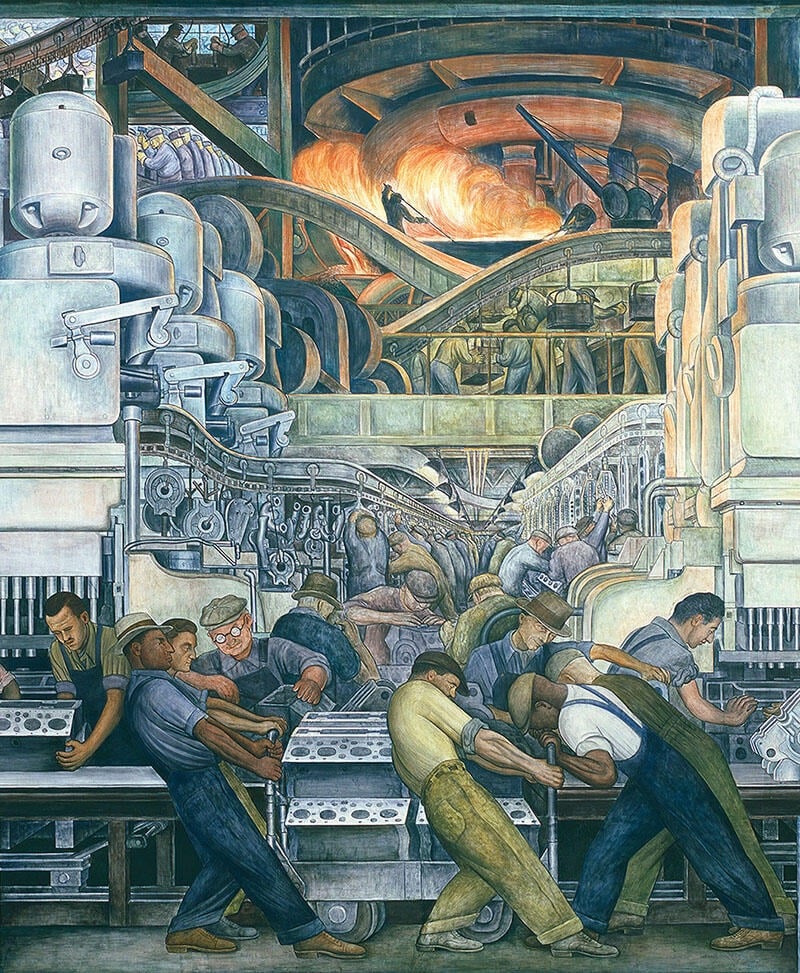
Diego Rivera, Detroit Industry Murals (1932–33)
Rivera’s Detroit Industry Murals expand the article’s inquiry from psychological disposition to structural consequence. Human figures are no longer isolated or concealed; they are synchronised. Bodies, tools, and machines merge into a single rhythmic system, where individual agency dissolves into collective productivity. The worker is not erased, but absorbed—rendered functional, repeatable, and ultimately interchangeable.
Within this framework, Rivera’s murals complicate the notion of harm. There is no overt violence here, no visible cruelty. Instead, the paintings present a world in which efficiency itself becomes the organising moral principle. When systems operate smoothly, responsibility diffuses; when outcomes are productive, ethical cost becomes difficult to locate. Harm is not denied—it is normalised through scale, routine, and necessity.
Placed near the conclusion of the article, Rivera’s work serves as a visual reckoning. It asks whether emotionally detached leadership, once embedded within vast institutional structures, ceases to appear pathological at all. When systems reward control over care and output over consequence, the question is no longer who holds power—but what kind of inner life such systems quietly require.
Perhaps the easiest way to talk about dark personalities is to isolate them — to treat them as anomalies, deviations, and pathological cases. In doing so, the problem remains individual, while the system remains innocent.
But if the absence of empathy becomes a professional advantage, if moral distance is mistaken for maturity, if the capacity to cause harm without hesitation is rebranded as leadership, then the dark personality is not an aberration. It is a logical outcome.
And perhaps the most uncomfortable question is not whether our systems produce toxic leaders, but:
whether they are capable of producing any others at all.
Reference List
Arendt, H. (1963) Eichmann in Jerusalem: A Report on the Banality of Evil. New York: Viking Press.
Babiak, P. and Hare, R. D. (2006) Snakes in Suits: When Psychopaths Go to Work. New York: HarperCollins.
Dutton, K. (2012) The Wisdom of Psychopaths. London: William Heinemann.
Foucault, M. (1980) Power/Knowledge: Selected Interviews and Other Writings 1972–1977. New York: Pantheon Books.
Hare, R. D. (2003). The Hare Psychopathy Checklist–Revised. Toronto: Multi-Health Systems.
Mitchell, K. L. (2024) Psychopaths, Narcissists, Machiavellians, Toxic Leaders, Coercive Controllers: Subsets of One Overarching “Dark” Personality Type? PhD thesis, Swinburne University of Technology.
Nietzsche, F. (1886) Beyond Good and Evil. Leipzig: C. G. Naumann.
Paulhus, D. L. and Williams, K. M. (2002) ‘The Dark Triad of Personality’, Journal of Personality and Social Psychology, 82(3), pp. 556–563.
Image References
Magritte, R. (1964). The Son of Man [Oil on canvas]. Private collection.
Grosz, G. (1926). The Pillars of Society (Stützen der Gesellschaft) [Oil on canvas]. Nationalgalerie, Berlin.
Bacon, F. (c. 1940s–1970s). Figures in Isolation [Series of oil paintings]. Various collections.
Rivera, D. (1932–1933). Detroit Industry Murals [Fresco murals]. Detroit Institute of Arts, Detroit.
ADVERTISEMENT