
A LOVE
An exploration of Gluck’s Medallion as a radical act of queer self-representation, where love, identity, and visibility are fused into a single, defiant image
by Sezer Ali | DEC 19, 2025 | ART & IDENTITY


FUSED IN PAINT
MORE THAN A PAINTING
In 1936, the artist Gluck created a double portrait that would become their most famous work: Medallion, also known by the intimate name Gluck gave it, the ‘YouWe’ picture. At first glance, it is a striking image of two figures in profile, seemingly fused into one. But this artwork is not merely a portrait; it is a profound and courageous declaration of love, created in a world that was deeply hostile to its very existence. This analysis explores the historical context in which the painting emerged, the passionate love story behind it, its powerful visual construction, and its singular place within the history of queer art and self-representation.
A WORLD HOSTILE TO LOVE: The Context of Medallion
To understand the courage embedded in Medallion, we must first understand the world in which it was painted. The early twentieth century was not merely an era of silent disapproval; it was an active battleground of ideas. While courageous voices such as anarchist activist Emma Goldman and sexologist Magnus Hirschfeld publicly defended queer love as a natural variation of human experience, dominant Western culture responded with moral panic and legal repression, rendering any visible expression of same-sex love a dangerous act.
The legal landscape in Britain was particularly perilous. Oscar Wilde's imprisonment in 1895 starkly illustrated the reality of criminalising homosexuality between men. Although lesbianism was not explicitly illegal, this absence of legislation reflected intolerance. When Parliament debated the criminalisation of lesbian relationships in 1921, lawmakers ultimately decided against it, fearing that public discussion would merely draw attention to their existence and encourage women to explore them. The result was a policy of enforced invisibility rather than acceptance.
Aggressive cultural campaigns reinforced this invisibility. In 1928, James Douglas, editor of the Sunday Express, launched a virulent attack against Radclyffe Hall’s novel The Well of Loneliness. Despite the novel’s restrained tone, Douglas articulated the era’s hysteria in a now-infamous condemnation: “I would rather offer a healthy boy or a healthy girl a phial of prussic acid than this novel. Poison kills the body, but moral poison kills the soul.” (Douglas, 1928) The novel was subsequently censored, yet its emotional core—particularly the line “…and that night, they were not divided”—resonated deeply with queer readers.
This notion of an inseparable union forged in defiance of a hostile world is precisely the emotional territory Gluck explores in Medallion. But rather than articulating this defiance in literature, Gluck chose to render it in oil and paint, transforming private love into a visible, enduring image at a time when visibility itself was a radical act.
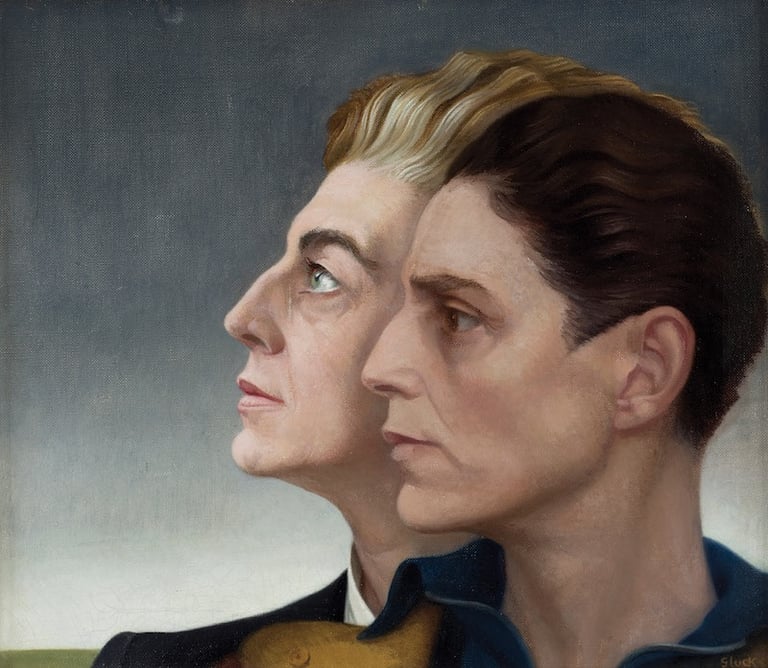
Fig. 1. Medallion (YouWe) by Gluck, 1937, oil on canvas, 12 x 14 in. (30.5 x 35.6 cm)
THE ARTIST AND THEIR GREAT LOVE
Introducing Gluck
The force behind this revolutionary painting was a singular artist whose life and work consistently resisted categorisation. Born Hannah Gluckstein in London in 1895, Gluck adopted the gender-neutral name “Gluck” and insisted upon its exclusive use, often attaching a note to their works that read: “Please return in satisfactory condition to Gluck, no prefix, suffix, or quotes.” Gluck rejected the label of “woman” and cultivated an identity that resisted binary definition; accordingly, this analysis uses they/them pronouns.
This fluidity extended into Gluck’s personal relationships. To the queer artist Romaine Brooks—who painted Gluck’s portrait Peter (A Young English Girl)—they were Peter. To their great love, Nesta Obermer, they were Tim. These shifting names reflect an identity shaped relationally rather than fixed socially.
Born into an exceptionally wealthy family, Gluck possessed the rare privilege of financial independence. This autonomy freed them from the economic dependence on men that constrained many women artists of the period, allowing Gluck to pursue painting on their terms and to approach love as an existential commitment rather than a social compromise.
A Love Story for the Ages
Nesta Obermer, the wife of a wealthy American businessman, lived a life of travel, glamour, and social excess. When she met Gluck, the connection was immediate and overwhelming. Gluck’s surviving letters testify to the intensity of this attachment. In one, they wrote:
“My own darling wife. I have just driven back in a sudden, almost tropical downpour in keeping with my feelings at leaving you – my divine sweetheart, my love, my life… everything seems so utterly unimportant that isn’t us or connected with us.” (Gluck, c.1936)
For Gluck, this relationship was not an affair but a marriage in all but legal recognition. “Darling Heart,” they wrote in another letter, “we are not an ‘affair’, are we? We are husband and wife.” (Gluck, c.1936–37) This self-declared marital bond—chosen, mutual, and emotionally absolute—forms the emotional nucleus of the YouWe picture.
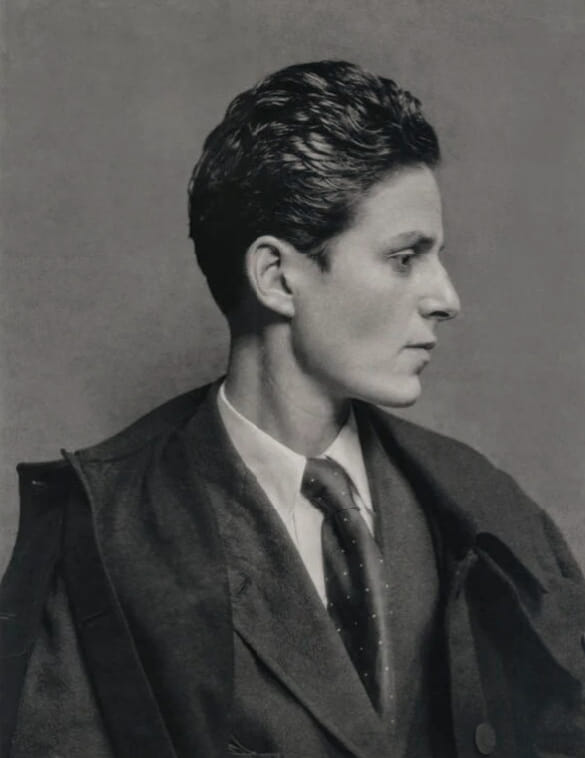
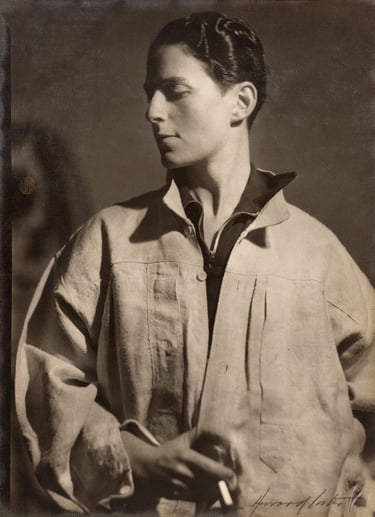
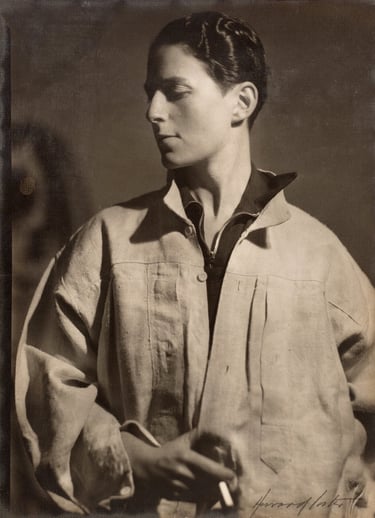
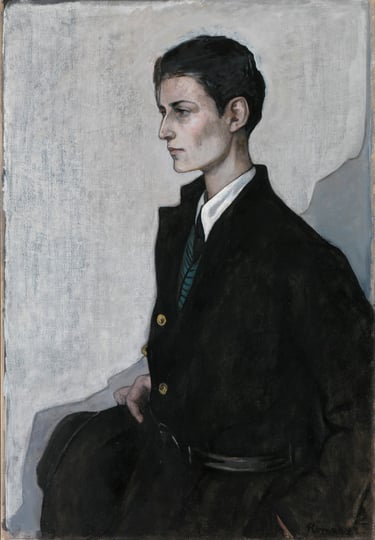
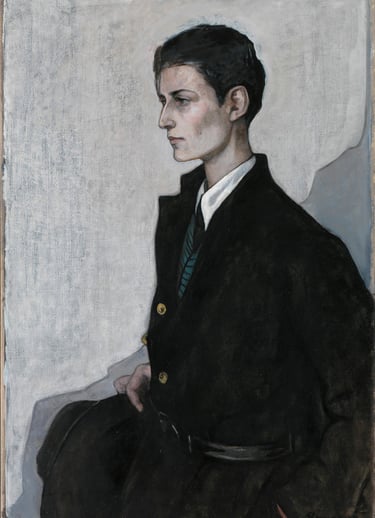
Fig. 2. Gluck by E.O. Hoppé, 1924, Fig. 3. Artist Gluck. Courtesy of The Fine Art Society Limited, Fig. 4. Peter (A Young English Girl) by Romaine Brooks, 1923
ARTISTIC CONTEXT: Outside Movements, Against Categories
Although Gluck worked during a period of intense artistic experimentation, they resisted affiliation with modernist groups or stylistic movements. Gluck rejected labels such as modern, traditional, or avant-garde, insisting instead on complete artistic autonomy. This refusal extended to the presentation of their work: Gluck famously designed the “Gluck frame”, an architectural, moulded frame intended to be inseparable from the painting itself, reinforcing the idea of the artwork as a self-contained object rather than a reproducible image.
This insistence on control also shaped Gluck’s relationship with institutions. They resisted reproduction, clashed with critics, and carefully managed how their work entered public view. Within this context, Medallion must be understood not as an accidental confession but as a deliberate, controlled act of visibility—a work that asserts both artistic authority and emotional truth.
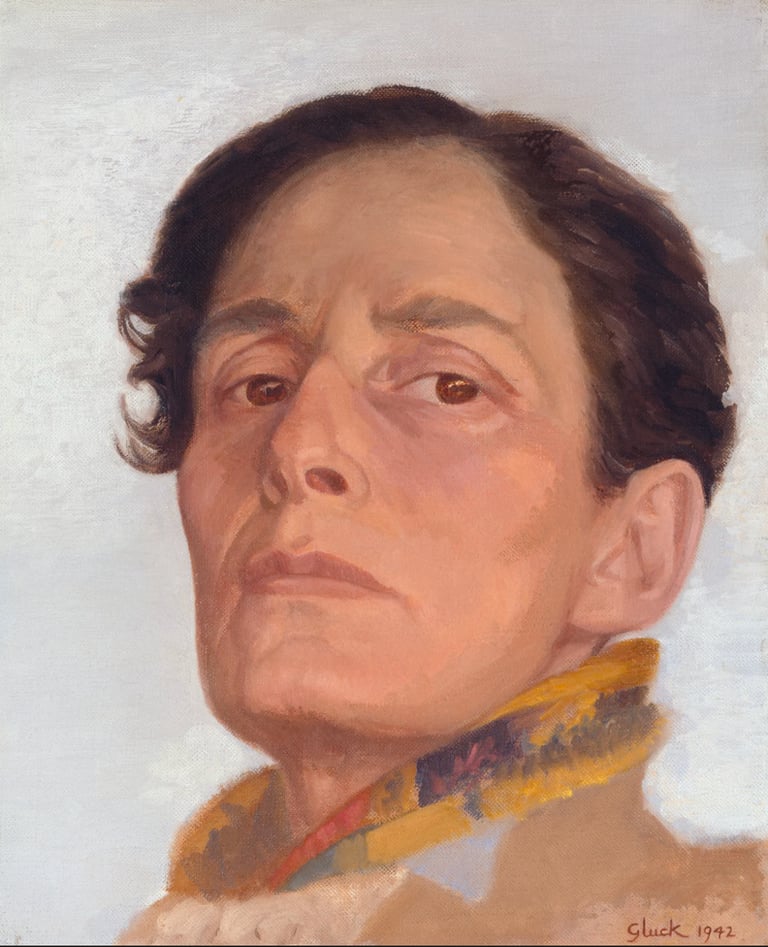
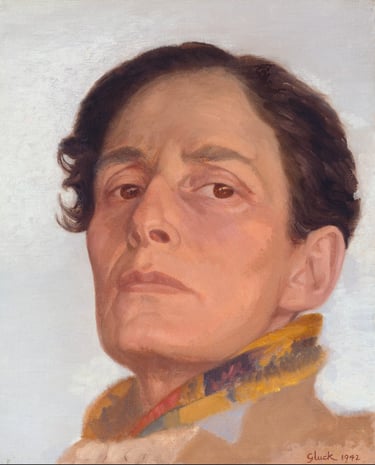
Fig. 5. Self-Portrait by Gluck, 1942
Painted during a period of profound personal crisis, this self-portrait is often read as a visual expression of emotional pain and vulnerability following the gradual breakdown of Gluck’s relationship with Nesta Obermer. The withdrawn gaze and subdued presence mark a departure from earlier portrayals of confidence and control, revealing self-portraiture here not as self-assertion, but as an act of raw emotional exposure.
DECONSTRUCTING MADALLION (The YouWe Picture)
The Moment of Inspiration
The painting’s origin can be traced to a single, intensely felt evening. On 23 June 1936, Gluck and Nesta attended a Mozart concert. The music’s emotional force was so overwhelming that Gluck later described it as having fused the lovers into a single being. Medallion is a direct visual translation of that moment of transcendence.
A Visual Breakdown
The composition of Medallion carefully guides the viewer toward perceiving two individuals as one unified form. Nesta, positioned in the background, gazes upward with an almost heroic serenity. Light falls gently across her face, lending her an ethereal, idealised appearance. In contrast, Gluck occupies the foreground, their gaze steady and forceful. Rather than portraying oneself with conventional beauty, Gluck emphasises solidity, resolve, and possession.
Together, the profiles merge into a single medallion-like form. Gluck’s darker, grounded presence functions as a stabilising base, from which Nesta’s illuminated face emerges. The result visually mirrors the structure of their relationship: Gluck as the steadfast, grounding “husband”, and Nesta as the idealised “wife”.
The choice of the medallion form is itself significant. Traditionally, medallions hold intimate portraits of loved ones, carried close to the body as objects of memory, devotion, and belonging. By enlarging this private format into a public painting, Gluck transforms an intimate symbol into a monumental declaration of unity.
A Public Misreading
Because queer relationships were rendered culturally invisible, the painting’s meaning was long misinterpreted. Many viewers failed to recognise the image as a portrait of two lovers, instead reading it as a symbolic depiction of Gluck and an alter ego. This misreading reveals the limitations of a heteronormative gaze: when love between women could not be imagined, it was reclassified as introspection or psychological symbolism. The absence of established visual codes for lesbian intimacy rendered genuine love effectively unreadable.
A RADICAL DEPARTURE: Gluck’s Vision of Queer Love
The Historical Gaze: A Pattern of Sexualisation
Male artists historically dominated the production of representations of women's relationships, filtering them through a voyeuristic, eroticising gaze. Emotional intimacy was subordinated to spectacle.
Gustave Courbet’s Le Sommeil (1866), painted for a private male collector, depicts two nude women entwined in erotic repose and remained hidden from public view for nearly a century (Nochlin, 1971). Henri de Toulouse-Lautrec’s late nineteenth-century lithographs frequently portrayed lesbian women as spectacles of urban decadence rather than subjects of emotional depth (Foster, 1996). Franz von Bayros’s Erzählungen vom Toilettentisch (1911) pushed this tendency further, presenting lesbian sexuality alongside taboo and transgression in explicitly pornographic imagery (Loyrette, 2010).
Across these works, lesbian relationships function less as lived realities than as projections of male fantasy—sexualised, exoticised, and ultimately dehumanised.
Gluck’s Revolution: Love, Not Perversion
Medallion stands in radical opposition to this tradition. Gluck depicts queer love from within, not as a spectacle but as a lived truth. The painting refuses an erotic display, instead emphasising emotional intimacy, mutual recognition, and spiritual fusion. In doing so, Gluck rejects the historical framing of lesbianism as perversion and asserts it as a legitimate, dignified form of love.
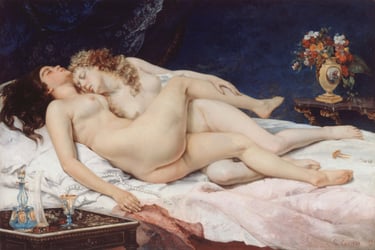
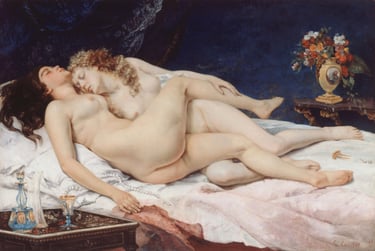
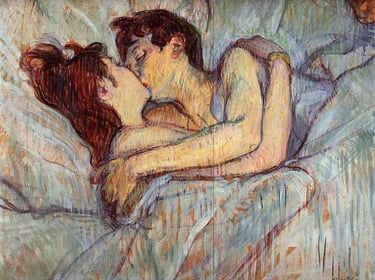
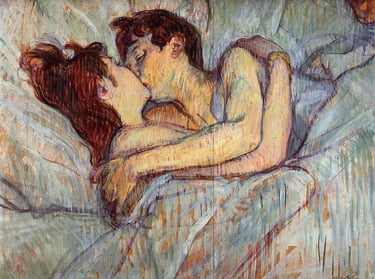
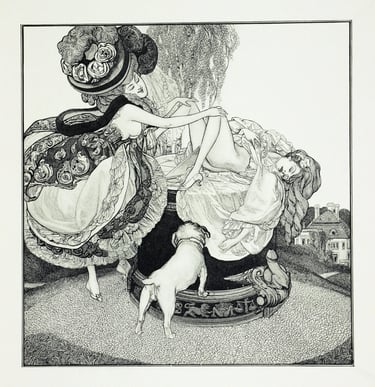
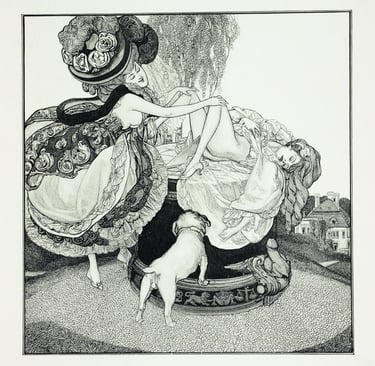
Fig. 6. Le Sommeil by Gustave Courbet, 1966, Fig. 7. Au lit: le baiser by Henri de Toulouse-Lautrec, 1892, Fig. 8. Erzählungen am Toilettentisch by Franz von Bayros, 1911
AN IMMORTAL, IMPOSSIBLE LOVE
The love immortalised in Medallion could not endure. Nesta ultimately remained with her husband, and the relationship ended in 1944. A 1942 self-portrait by Gluck is often interpreted as an expression of grief and emotional devastation, painted in anticipation of this loss.
Yet while the relationship ended, the YouWe picture endures. It is more than an image of an impossible love; it is a monument to a love that society refused to acknowledge. To look at Medallion today is not merely to observe a historical artefact, but to participate in the recognition of a truth once forced into silence. By refusing sexualisation and insisting instead on emotional and spiritual depth, Gluck secured Medallion a vital place in queer art history—as an early, unapologetic act of self-representation and a testament to a love that dared declare itself whole.
References
Douglas, J. (1928). ‘A Book That Must Be Suppressed’, Sunday Express, 19 August.
Gluck, Letter to Nesta Obermer, c.1936. Quoted in Tate Britain Archives.
Gluck, Letter to Nesta Obermer, c.1936–37. Quoted in Cooke, R. (2017) Gluck: Art and Identity. London: Tate Publishing.
Nochlin, L. (1971). Realism. Harmondsworth: Penguin.
Foster, H. (1996). The Return of the Real. Cambridge, MA: MIT Press.
Loyrette, H. (2010). Gustave Courbet. Paris: Gallimard.
Cooke, R. (2017). Gluck: Art and Identity. London: Tate Publishing.
Image credit
Fig. 1. Medallion (YouWe) by Gluck, 1937
Fig. 2. Gluck by E.O. Hoppé, 1924
Fig. 3. Artist Gluck. Courtesy of The Fine Art Society Limited, 1932
Fig. 4. Peter (A Young English Girl) by Romaine Brooks, 1923
Fig. 5. Self-Portrait by Gluck, 1942
Fig. 6. Le Sommeil by Gustave Courbet, 1966,
Fig. 7. Au lit: le baiser by Henri de Toulouse-Lautrec, 1892,
Fig. 8. Erzählungen am Toilettentisch by Franz von Bayros, 1911