
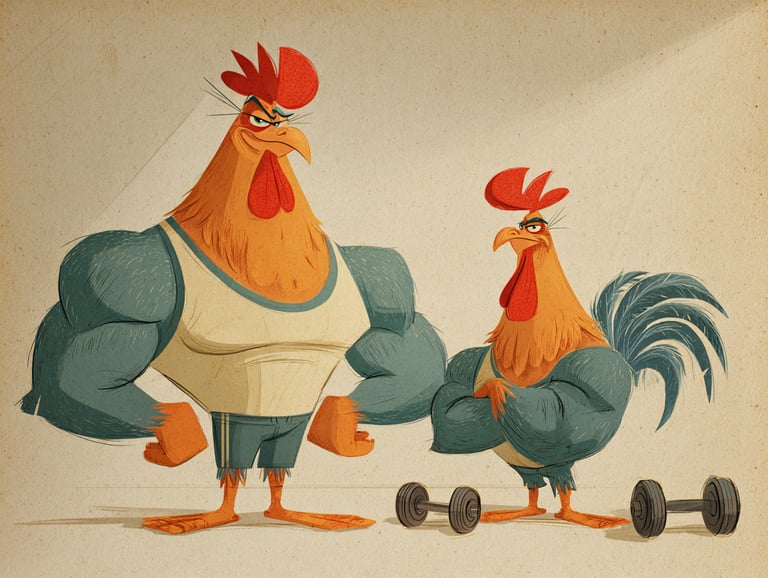
The gym after the holidays is not just busy — it is theatrical. A space where bodies don’t merely move; they speak. Somewhere between the bench press and the mirror, a familiar ritual unfolds: the urban choreography of the Cocky Rooster — the man who doesn’t simply train but performs presence.
The Cocky Rooster is easy to spot. Slightly raised shoulders, chest pushed forward, a walk that assumes the air should make room. Each repetition is slow and deliberate, not so much for the muscle as for the reflection. The mirror is not a tool here; it is an audience.
As I rest between sets and watch him, an ethnographic comparison inevitably comes to mind. In the animal world, the rooster follows a clear script: puffing up, displaying, making noise, and occupying space. The goal is simple — to be seen, recognised, and chosen. I’m no biologist, but the choreography feels uncannily familiar. The difference is that here, feathers are replaced by tank tops, and the henhouse by a monthly membership.
From the outside, the scene is comic. A group of men, each locked into his own heroic pose, barely interacting. Every one of them a solo performer in a collective choreography. Roosters without a farm but with Bluetooth headphones. This is not a competition, of course—it’s just that everyone knows exactly how much everyone else lifts.
But if we pause the laughter for a moment, it becomes clear that this isn’t just vanity. This is the bodily language of masculinity — still often experienced as something that must be proven. Again and again. With weights. With posture. With silent rivalry.
COCKY ROOSTER
An ethnographic observation at the gym
by Sezer Ali | JAN 14, 2026
The gym is one of the few places where the male body is allowed to exist unapologetically as a project. There is no concept, no irony, no cultural filter. The body is the argument. The muscle is the sentence. The pose is the exclamation mark.
The Cocky Rooster is not a caricature but a symptom. When vulnerability is difficult to admit, the body becomes the spokesperson. When emotional language is restricted, physical language grows loud. Confidence here is often exaggerated, performative, almost theatrical — because it masks an insecurity that has no other outlet.
The humour lies in the collective nature of the scene. Everyone is quietly checking who lifts what, who takes up more space, and whose reflection catches whose eye. A silent competition with no real winners — a ballet of ego where everyone knows the steps, but no one admits they’re dancing.
And let’s be honest: this model doesn’t live only in the gym. We meet him in offices, on social media, and even in cultural spaces. But here — among mirrors and weights — he is stripped down to his essence. No captions. No filters. Just body and gesture. If the gym is a stage, the Cocky Rooster is an actor without a script — but with a very convincing stance.
As an observer, I don’t place myself outside the scene. The difference between me and the Cocky Rooster is that I at least admit I’m watching. Perhaps that’s why, instead of mockery, I feel curiosity. Because in this circus of strutting roosters there is something painfully familiar: the need to be seen, acknowledged, and chosen.
The next time I pause between sets and catch the Cocky Rooster in full display, I’ll probably smile again. But I’ll know this much—it’s not just a funny pose. It’s the weight of a masculinity still searching for its language.
"If the gym is a stage, the Cocky Rooster is an actor without a script — but with a very convincing stance."
The muscle becomes the sentence. The pose, the exclamation mark.
Cocky Rooster
An Ethnographic Observation at the Gym